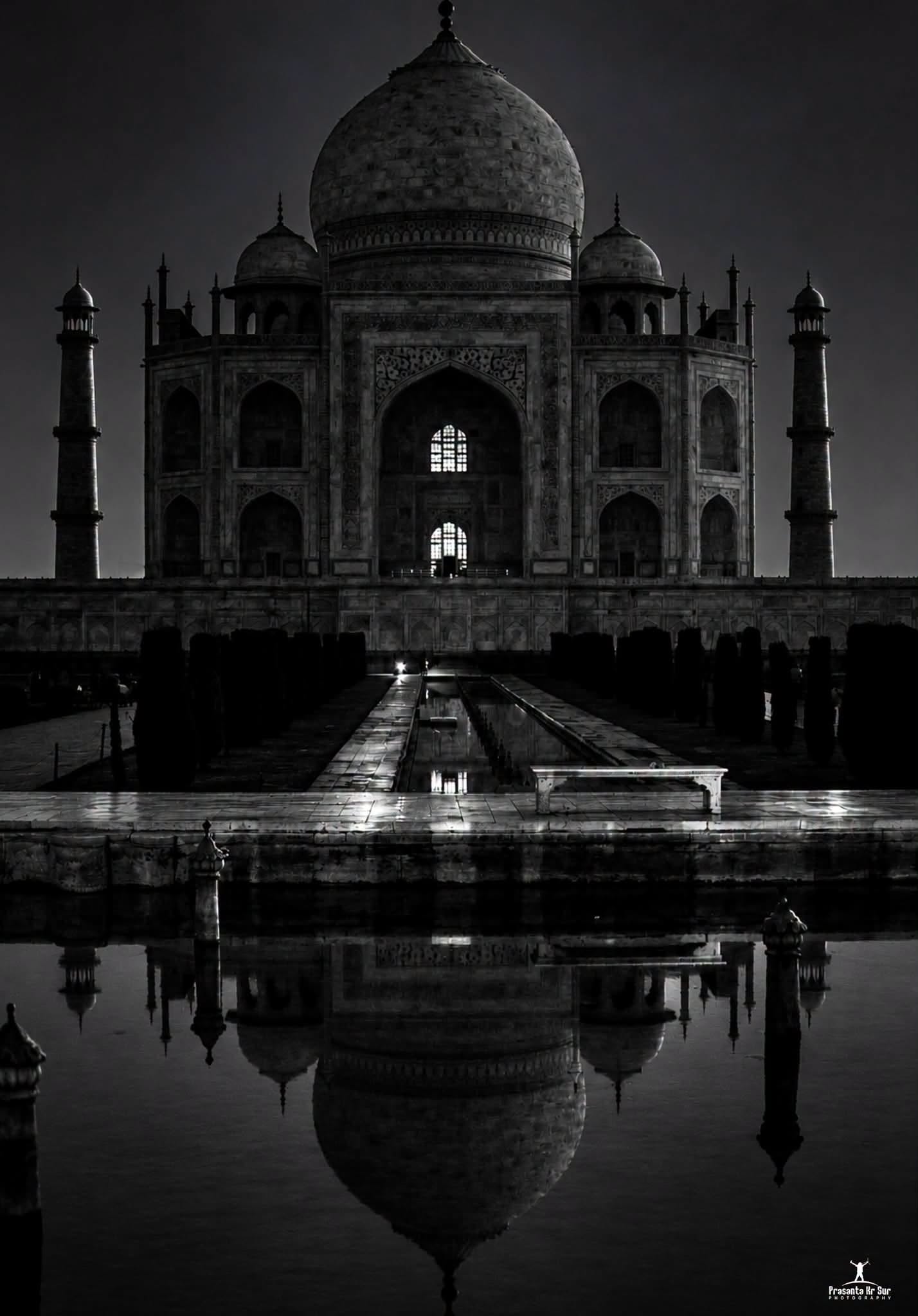
It is at last in this photo that I see the Taj in full moonlight. My mother had once been to the Taj on a full moon night with my father on their honeymoon. She simply said that it was surreal; despite being an articulate person with a commendable command of language, she could never quite speak about how the monument looked in the full moon. A famous photographer said that in the full moon, the Taj disappears under its own shadow with the white dome gleaming in the light of the night looks like a heavenly figure suspended from the sky. Quite a few Bengali litterateurs have mentioned looking at the Taj at night but never quite described the visual. It is, as I see in the post below, the Taj looks like in the picture. On a full moon night, the Taj darkens out so totally that it looks like a structure made from black stone. There is no whiteness of it in contrast to the darkness of the night, there is no disappearance of the Taj into its own shadows when the moon reaches its pinnacle in the sky and there is no surreality of a suspended dome from the sky. The Taj simply turns into darkness and with the gleam of the moonshine on its waters, the universe becomes a black and white photograph. That’s all.
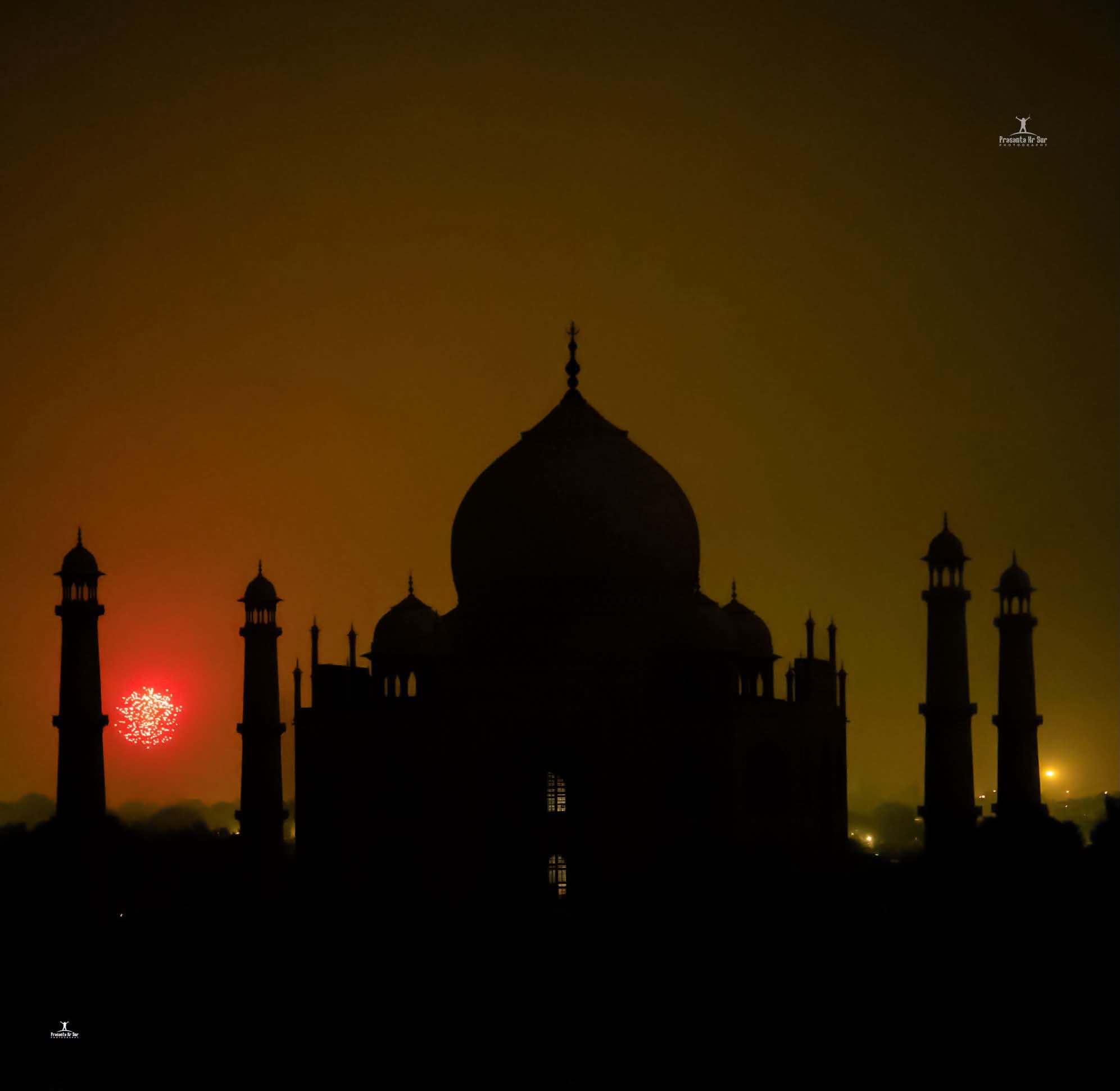
Then again, when the sun rays reach the horizon, heralding that the sun is about to rise, the moments when the sky is red at the edges frayed with yellow at the centre and largely deep blue elsewhere, the Taj becomes a dense block of pure black. In the sun, the Taj is the Ketu, totally obfuscating the light. Here the Taj absorbs the light by becoming dark itself, absorbing life becomes the death it is meant to be.
In the bloom of the moonlight, the Taj turns into a shadow, like a ghost, translucent, transparent, pure soul, shorn of its flesh, shorn of its glamour, it becomes the essence of life that remains indestructible, belying the life that becomes apparent in broad daylight.
The Taj is a monument of endless possibilities, infinite meanings, unfathomable codes. It is, in short, a phenomenon.
Pictures are from FB Page of Prasanta Sur