The Hindu right-wing nationalists seem to have abandoned the term Hindutva in favour of Sanatan Dharma for gearing up for the next level of esoteric and cultist politics. Hindutva was a poorly defined idea that tried to convert the precepts of Hinduism into a creed that closely resembled the Abrahamic religions. But there were far too many claimants for Hinduism against whom, Hindutva did not have an impregnable defense and hence one puts forth the Sanatan Dharma. Let us see what it means.
Sanatan means the eternal. What can be eternal unless it is some kind of naturalism, where humans are born in a state of Nature, or natural freedom, where freedom means lack of opposition from anything because s/he is fully aligned to the cosmos. In practice this can mean a set of pagan practices those which existed before any form of textually or ecclesiastically organized religion. However, the term Sanatan has been used more politically to contest something related to human will in a political outcome. Krishna uses Sanatan Dharma to ask Arjun to kill his natural relatives because he is in a war of morals. Morals, a human, and a political construct is placed as the natural value over what really is the natural, namely the family.
Sanatan Dharma was the bogey raised by Bengali Brahmins to uphold every possible heinous act against humanity. Sati, child sacrifice, human sacrifice and cults of killing were paraded as being instances of Sanatan Dharma. Here, not naturalism but Sanatan meant the eternal truth as drawn from the Goddess, usually Kali. Rammohun Roy was the first one ever to coin the term Hinduism in 1816 to contest the eternal truth justifying murder and, in some cases, even genocide. Hinduism was pitted against Sanatan Dharma. Ever since the days of the Brahmo Samaj and the slew of reforms that followed across India, Sanatan Dharma came to mean the pre-reformed Hinduism. Bankim Chandra has the Sanyasis and Fakirs say that now the Mussalman regime is over, the Company will help Indians protect the Sanatan Dharma, here he means the ascetics, who because of their asceticism claim to be purer Hindus. Louis Dumont, in his seminal essay on Renunciation echoes a similar observation that Sanatan means the open space (not liminal) of the individual and her Divine beyond the compulsive rituals of worship. In this opinion, the authentic/natural/eternal religion is only to be recognized as the eternal and intransient.
Somehow, all through the period of social and religious reform, the idea of Sanatan Dharma has resisted a reformed Hinduism. Sanatan Dharma is thus a resistance to a modernized Hinduism, or an assertion of those who have been unable to grasp modernity and have remained unadapted to the many social changes which those better adapted could make use of. Modernity has undoubtedly created inequalities, between those who could access its opportunities and those who could not. Sanatan Dharma, like the Hindutva nationalism is the assertion of losers, a search for a paradigm that would place them at an advantage over their better off fellows by undoing all the victories of a reformed religion and it adaptive powers to modernity.
The unemployment levels in India are naggingly high. Despite it being the third largest economy in the world, India does not seem to generate enough offers for its job seekers. On the other hand, the factories and establishments complaint that there are not enough takers for positions advertised. Yet, when we hear reports of crores of rupees being paid to bribe Ministers for government jobs, we sense both the desperation on part of the society to be employed and the ability to pay a huge sum as bribe to procure that, if the last mentioned is counted as willingness to work. How does one explain the paradox?
In the minds of humans in India, i.e., Bharat, the idea of a job is just an entitlement for a dole. Those who are in offices are looked upon as the idle class, who no longer need to work for a living as a salary is assured. This is the most crucial difference between British India and independent India. In British India, the clerk had to work very hard to levels of oppression and enslavement. In Independent India, a job makes you part of an establishment, a partaker of the ruling class and which is looked upon as being a leisure class that need not work for its living. My father tells me that when India got Independence people were elated thinking that now everything would come for free; no need to pay the tram fare or the train fare and no need to work for a living as wages would flow in automatically. My father thought that it was bizarre because how would wealth be generated without any work or exchange? He was a smart teenager at 13 years old but truly most in the streets felt that work meant only slavery, freedom, as an end to work and the start of life as leisure. The Congress made it sure, and Tagore graced it with his song, that all of us would be rulers in a sovereign state and the people took it literally to claim sovereignty for themselves by abandoning work. The common saying in Bengali, that I draw my salary if I sign attendance in office but I need to cash in overtime if I deliver my tasks. Salary and work are disconnected in the Indian mind, as work and success are disconnected too. In a strange quirk of Calvinistic predestination, you earn money for what you are, not for the work you do. It is the attitude towards work, its construction in the minds of humans that a job is an entitlement and not a responsibility to deliver that creates this paradox of people desiring a job but not wanting to provide services. As our household help fondly remembering his deceased father who held a government service, says that not a single day did he attend office and was so privileged that he died consuming too much alcohol out of his salary.
A government job is lucrative for its security and since it is seen as disconnected to performance, it is also seen as the perfect ticket for a life of leisure. Our education is thus oriented towards the acquisition of leisure; you study hard to obtain leisure by way of a secured job and a regular salary. The despicable state of India’s education standards, its inability to produce intellectuals and innovators, its need to copy and imitate rather than produce original work, the institutional intolerance for creative thinking are all parts of the single coherent whole of its attitude towards work. The Weberian thesis of calling that underlies all professional development is unearthly to the Indian. The crisis of skills is India’s next famine.
In case one must work, then Indians prefer to be on their own. The informal sector, made up mostly of delivery boys, cab drivers, maids and servants, care givers and paramedics, private tutors and dalals is not merely one of unabsorbed labour by the industry but also of the labour unwilling to be employed full time. Though one can give lakhs of rupees as bribe when, it seems unbecoming that labour would be as willing to join work for a lesser employer. It is the status of the employer, which if it is high enough will attract labour force towards it and still higher, such as the defenses that will make people willing to work for the same; in case it is a private employer, then labour supply is as scarce, if not scarcer than capital.
Individualism in India is about entitlements and not about agency. The persona is acquisitive, what one gets rather than what one delivers. Despite its poverty once upon a time, despite its ascetic aversion to consumption, sometime not long ago, India is an acquisitive society. Here, humans corner social entitlement, caste system can never go away. The acquisitive individual is the direct antagonist of the agency. The purpose of an agency is to contribute and increase the whole; the purpose of acquisitiveness is to sustain off the whole. Both may have pride in the nation, but one seeks ways to contribute towards its growth, the other finds ways and means to sponge off from the growth already attained. Liberal politics is the politics of agency; the acquisitive mind finds agency as passe, as silly people who are not smart enough to grab. Acquisitive individuals cannot grow anything; like the proverbial greedy animals, they come to partake in the cake baked, having been absent all through the process of baking it. Lack of skills, dysfunctional education, corruption in public life and the rise of totalitarian politics are connected in one straight line all of which emanate from the way work is conceptualized in India.
In my long years of studying and practicing economics, I must have read at least 200 articles and books on the MSMEs. In each work, the idea presented of the MSMEs is a small unit, run by an entrepreneur with few workers and low mechanization and is taken to be a self-contained unit which procures raw materials and produces for the market. Policies have been formulated upon such erroneous assumptions, reinforcing the errors around the MSMEs. Indian industries rests heavily upon the MSMEs, most often the traditional ones, such as textiles, brass, glass, gems and jewelry and food processing. In none of the above industries, we have small self-contained units producing for an impersonal market; instead, each of the units is a branch of specialization which together form a huge supply chain for an agent or a contractor who is at the peak of this pyramid, negotiating with the market forces. This is the picture of the Moradabad brass industry in which numerous units can be considered as shops of a giant production system.
In the old part of Moradabad, typically that lies on the Rampur Road, the city divides and subdivides into narrow alleys with concrete houses that hosts a “factory” each on the ground floor with the upper floors being used as residential areas. Each of these “factories” specializes in one or more processes, namely casting, moulding, forming, stamping, extrusions, etching, wire drawing, polishing, finishing, painting, and coating and of course metal pasting. These units may be considered as being “shops” of a giant factory whose turnover is Rs 8000 – Rs 9000 crores. Such an industry is not small scale. At Rs 1000 per kg, Moradabad produces about 8000 to 9000 tonnes of brass annually.
Most of the work, even before the age of electricity in India was done by hand operated machines. Levers, wheels, axles albeit operated by hand were cleverly designed to produce high turn speeds producing therefore moulded products of impeccable quality. Clever and patient hands did the etching on heated metals. There was always a profuse use of dies for impressing designs on metals. Moradabad was named after Prince Murad, a son of Shah Jahan, also a contender for the Mughal throne and eventually slain by Aurangzeb in the war of succession. The brass units are overwhelmingly located along the Prince road, the road through which drove Prince Murad.
The health of this industry depends on the market; brass being a luxury and leisure item used mainly for decoration and for sacred rituals, domestic markets will always remain too small. Brass has always been and will forever remain, a global item depending on exports. The basic material, copper, and zinc, is found widely across the world and is also easily imported, but the organization of skilled labour willing to work seems to be the crucially decisive factor. Moradabad must count on its fortunes that it has no dearth of skilled workers willing to work in factories.
Given the dependence on exports and the shrinking demand for brass across the world, Moradabad brass industry is struggling, not with issues of scaling up but with issues of excess capacities. Mechanization is not about scaling up nor about replacing labour, because manual skills as needed to operate machines as well; it is about the need to avoid the heat of metal working and to reduce the exposure of workers to metal gases and emissions. The only problem with mechanization is the lack of space in factories; hence the metal working and finishing centres. This means that there is likely to be a lot of movement of workers across the premises from one house to another, namely where the machines are kept.
The principal materials for brass are copper and zinc. India had comfortable reserves in but these, especially of copper has depleted fast leaving the country deficit in both. Copper is imported today and whatever zinc is produced is diverted to the ever-growing stainless-steel industry. Copper too largely goes to the power sector. Whatever comes to the brass industry are the leftovers, often at a high price. Dependence on scrap has increased, which is also imported. Moradabad NGOs have developed a raw material bank to secure assured supplies of the material.
To be able to use the machines to full capacity, and to utilize skilled labour more fully, brass workers are graduating to working with aluminum and steel, coating these with gold coloured lacquer to make these appear as brass. This has changed the hues of the industry literally, expanded its scope of products. If there is a scope for expansion and hence mechanization, then it is in the metals other than brass.
Indian government has banned imports from China and it’s Made in India mission purports to build all machines in India. The Indian made machines, like the swadeshi or yore are poor and expensive; industries are suffering everywhere due to a near total ban on Chinese machinery. But the states run by the BJP governments merrily import Chinese machines; UP is no exception. Chinese machines are imported through Ghaziabad and Moradabad units import from Ghaziabad, both being in UP. Ludhiana, in Punjab the traditional hub of machinery lies vacated as there are no buyers of indigenous machinery in the country; to concentrate industries in BJP led states, only BJP ruled states are allowed imports from China; machinery, scrap, commodities. The totally unintelligent opposition has failed to see this glaring anomaly.
There was a report in Wire as to how a politics of Hindutva and banning Muslims from the economy has hurt Mordabad. Yes, it did as the Dalits were eager to takeover the jobs from the Muslim workers in the brass factories. Unfortunately, even the diehard Hindutvawadis realized that the Muslims who have been on the job for generations have genetically coded abilities not to be undone through mean politics of envy. The matter seems to rest now, the peaceful coexistence of the boisterous kanwars and the strutting Muharram processions perhaps vindicate the point.
Under the scheme of one district one cluster, Moradabad has been marked out for brass. Brass has lost its sheen, but the skills now rally behind various other kinds of metals. The cluster must be protected to protect skills, accumulated over centuries across generations, deposited in the DNA codes and so easily translated into more sophisticated metal working.
When we read Foucault’s set of interviews on Knowledge is Power, I think that our teachers did not understand the philosopher too well because we too held the mistaken notion for long that it is indeed that knowledge brings power. Bluntly, it does not. There is no power in knowledge and there never were great inventions which fueled the wheels of the great Industrial Revolution in the late 18th century originated as many as six centuries before then. Knowledge did not become power until it was put into praxis, or practice with a consciousness of knowledge it carries. It is not what is known, it is important what becomes the discourse, or the generally knowable and known. When knowledge is moved through the power system, whether of institutions, groups, associations, networks, cliques, media, or individuals much in circulation, it becomes discourse. The WhatsApp University is the ultimate instance of the discourse that minimizes the knowledge component and eventually eliminates it.
The circulation of posts about Guru Purnima is one such instance. A pagan festival of the full moon near the solistice, when the moon appears to be at the closest to the earth and hence feels the heaviest, and thus “guru” means heavy and large is celebrated across India. Such celebrations are accompanied by food, almost always heavy stuff, puris are stuffed and rolled large, savouries and sweets are made heavy by adding ingredients in the dough and so on. The Shaktas appropriated the custom by spelling the ambubachi, a time when the Goddess goes into menstruation. The earth gets moist and heavy and thus an agrarian society is likely to refrain from cultivating it. The Santhals have Meena Mangal and so do many tribes in the coastal region, where spawns are released into water bodies, and one refrains from eating them. Pagans let go of killing life and follow vegetarian diets albeit heavily cooked in oil. The Shaivas prepare for their annual jatras, Amarnath, Tarakeswar and the Kanwars. The Guru Purnima, then is not a specific day, instead it is a culmination or a peaking of the solistice between the months of Ashadh and Sravaan, the monsoons, which must be managed as between the rains being too light or too heavy. The rituals are many, all magical to control and contain the rains, metaphoric and allegorical. How such an ensemble of rituals becomes the ode to one’s teacher is mysterious. Yet, everyone suddenly seems to treat the pagan cult as a teacher’s day. This is the power of discourse.
The mistaken belief that it is a teacher’s day gets reinforced with each passing year where someone claims that Shiva taught some disciples, someone says that the Buddhist monks return to school. No one fact checks. That is not the problem; the problem is that no one thinks that there is something to be checked. The principal question in the circulation of fake news is why no one doubts. Then the problematic area is doubt.
Doubt emerges from a feeling that something does not fit the picture. Only those minds which have an idea of the picture can only doubt. The trouble then is that why do most minds not have a big picture? Detectives are more intelligent than most because of the way they can process data; those brains go by facts and evidence, matching a sentence to the corresponding fact. Detectives need to see data as part of a process; hence the brain would suddenly ask that worshipping a Guru on Guru Purnima seems so unusual in India because we are not those people who would have Mother’s Day, Father’s Day, or a Teacher’s Day. The only day which only the Bengalis have is the Jamai Shahsthi day, the day for the sons in law, part of Shashthi celebrations, marked to the jamai in one of its months. The doubt comes from unmatched data which means that the brain must work fast in data matching. Avid reading, constant observation, sharp memory and seeing the connectedness among things is thus the way to prevent the mind from accepting fake matter.
The trouble then lies in our pedagogy; students are encouraged to cram facts and the cramming takes up so much of the time, that the mind finds no space to devote to building wholesome pictures. The students become teachers, the tradition continues and soon a mass of humans in society lose their faculties of detection. The oft repeated stories of people video shooting a fatal accident instead of trying to rescue the victim is an instance of the deep penetration of discourse in ousting knowledge. Discourse is about cramming, using sentences to support sentences while knowledge is about the matching of data to the words. Innovative societies have knowledge, insipid ones have discourses.
Discourses are manufactured consent and moves through various forms of authority, religion, family school, peers, colleges, Universities, half-baked teachers and of course the media. Popular culture is a big carrier of unquestioning suspension of disbelief; the way it achieves its purpose is the story and the emotions. Discourse based politics seeks narratives with a beginning, middle and end layered with heavy weather emotions. The acceptance of words without doubt then is also a lack of neutrality. Neither authority, emotions, nor narratives help in neutrality. Neutrality is a state of mind to accept things objectively without the judgement of what ought to be and what ought not be. As we say, science should be positive and not normative. The normative belongs to politics; for there is acceptance and rejection. Pedagogy based on ethics is bound to be normative. This happens when pedagogy emerges from politics, French Revolution, American War of Independence, American Civil War, Civil Rights Movement, Indian Freedom Struggle, People’s War in China and so on. Politics of universality guides knowledge, teaches us acceptance because of the “what a great battle it was”, the nobility, the transcendence, the sublimity, and the emotions takes knowledge out of its context and uses “power” of textbooks, school boards, teachers, peers, competitive job exams to dispense discourses.
Political upheavals where one social class of elites displace the incumbents in power, invariably advance discourses through differently plotted narratives and differently invoked emotions of nobility. They capture institutions and use the existing ones to suit their needs. Discourse is power, without the discourse that survives through the formal and institutional structures, political power is not possible. The detective remains outside of the pale, often a retired police officer, or an independent individual, unattached to a job or profession. Regimes of political uncertainty, or regimes of political contest marginalize knowledge because knowledge is useless to seek power.
Knowledge is marginalized and so is the genuine intellectual. The intellectual who stands apart from social opinion is hard to find; intellectuals shamelessly seeking approval are strewn everywhere. Hence an argument is taken to be an offence; I say, and you listen, we are becoming apostles to one another. We are supposed to only like comments and not engage because you don’t engage with saints. Very quickly thus, politics takes on the form of religion because of the apostolic nature of discourse.
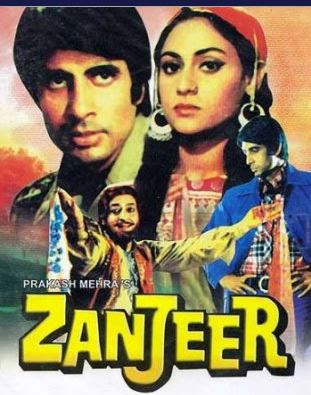
Question 1: 50 years ago, Zanjeer was a new and yet typical Bollywood film. Its stark novelty broke and yet reaffirmed the Bollywood formula. Based on the image of an Angry Young Man, Amitabh Bachchan started with a new flavour for the audiences. Whose credit was this? Amitabh Bachchan himself? Or the directors? Or the screen writers?
Answer: Most of the credit of Zanjeer and the new formula around Amitabh Bachchan must be given to the writers Salim Javed. Prakash Mehra saw the point and Amitabh Bachchan expressed the story. In a star-based movie, a lot of it is based on the star’s own personality and even biography. The star does best when roles are extensions of his/her life.
Cinematographically, Zanjeer has drawn so much from Uday Shankar’s film, Kalpana. Especially because of the dream being central to the story. It was about searching for the dream in the waking world.
Question 2: Do you think that Amitabh Bachchan expressed rebellion against the order or system? Especially as Zanjeer was released in 1973 and the Emergency declared in 1975? Around that time there were many rebellions, the Naxal movement, the slew of industrial and institutional strikes? Did Amitabh Bachchan represent the general angst?
Answer: No, that’s not true. The revolutionaries, because I lived in those times, so I know firsthand, always looked upon Amitabh as a stooge of the Congress. Rumours were afloat that Mrs Gandhi was setting up the star cast in the film! The intellectuals hated him and thought of him as a pro establishment person.
Question 3: Is that not a contradiction? He is a rebel and yet pro Indira Gandhi.
Observed carefully, Amitabh Bachchan and Indira Gandhi are parallel figures, bit as Yugapurush. Indira Gandhi was a rebel, she rebelled against the elders as in the syndicalists, she broke through many elitist bastions, the nationalization of banks, collieries, sick units, the BIFR, and brought 50 laws veering India towards a socialist economy. Amitabh also represented the attacks against the stagnancies of the system.
Question 4: You have mentioned that Amitabh Bachchan’s anger was not personal, it was universal. Did it represent the anger of the people?
People are always angry with something or the other. Arts and politics, both encash on it. In case of Amitabh Bachchan, especially in Zanjeer, he is troubled by a dream, or a nightmare of the past. The dream makes up edgy and eventually angry. He is angry at the disorder, anything disorderly. That dream is a disorder, the disorder from the dream spills into the real world. Strangely, it makes him become more aware of things out of place. The dream oppresses him and hence he becomes so frenzied when he senses oppression such as the children who were crushed to death by a speeding truck.
So, this anger against disorder comes from a separation of essence, contained in the dream and his existence. The alienation of existence from essence has marked the entire journey of the image of Amitabh Bachchan.
Question 5: If Amitabh and Indira Gandhi were on the same page, then what about the rebellions which were happening around us?
The rebels, Indira Gandhi, Amitabh Bachchan were all on the same page. Rebellions are often struggles to overcome limitations. With Indira Gandhi, a new age dawned on the country. We saw expansion everywhere, education, industry, agriculture, technology, these created opportunities for the middle class. The increase in population and the spread of education brought many more candidates into the workforce. There were both huge career opportunities as well as unemployment. So, everything had to expand to sustain the increase in opportunities for the youth to seize. Everybody wanted to expand, and everybody rebelled against limitations of systems wherever those applied.
We should not make too much of the image of Zanjeer, because that was a steppingstone. It was Deewar where the image took its shape. It is perhaps Amitabh’s only political film in the waxing phase of his career. The rest were stories about the separation of the essence and existence and of angst of the hero in trying to close that.
Question 6: Where do you think that the angry young man emerged from? He had predecessors in Hindi films? What about Ashok Kumar, the antihero in Kismet?
All heroes have been angry at the same thing, namely the limitations in the system. But for Amitabh, the anger was made into a central narrative and not as something that happens by the way.
There was another thing of the ability of the hero to fight; since the Hindi film was about the protection of the middle classes and the promotion of its aspirations for existential meaning, one of the major causes of its vulnerability lay in being attacked in the streets. Middle class respectability feared violence. Amitabh’s image ended that. It was not so much the expression of frustration, but a show of strength against the roadside goons.
Question 7: You mention that for Amitabh Bachchan, the films showed the hero’s full biography, from childhood to adulthood? Why was this necessary when anger was narrativized?
The narrative around anger made the biography. If it is a momentary anger, then it is an emotion, then it cannot be narrativized. Anger as a narrative need to ride upon the biography. Also the separation between the essence and existence, central to the image of the angry young man is an existential matter.
With the expanding opportunities and education, we see a lot of upward social mobility between 1967 and 1977. The birth rate is very high, so there is an urgency for the species to proliferate. That urgency translates into the image also as anger, you want to go fast and yet caught in a traffic jam.
Besides, in times of upward social mobility the biography becomes important because you are drawing upon your inner resources to break into new grounds. No one knows who you are, and you establish yourself, you are acquiring new skills and talents, the background becomes important.
Question 8: Where has the anger disappeared in our times?
We see anger all around us and all the time. Lynching, name calling, violent speeches, personal attacks, murder. So, anger has not disappeared at all. But because this anger is person to person, mostly against your neighbour, fellow traveller, family members, colleagues, it has little value for art. Art can only accommodate the universals, about reason, about rules. The anger we see at present times is personal, not systemic, about self-gratification and not about being a creative citizen.
Question 9. What about the role of Sher Khan that Pran played? Was he made into a Pathan to foster communal harmony?
Hindi films have always promoted communal harmony. So, nothing new about that. But Sher Khan was modelled around Kabuliwallah, the role which Chhabi Biswas enacted. Pran takes on the accent, the mannerisms, and the body language of the Bengali star. Also, remember that the hero was also a child in essence because the dream never freed him from childhood.
Question 10. Can the new generation be inspired by Zanjeer?
I don’t think so. Amitabh’s appeal lay in the middle-class intelligentsia. That class was the leading social class in the 70’s. Now we are totally disempowered into a middle class consumer class; since we neither possess nor desire nor are allowed to have any decision making in the system, what use would Amitabh Bachchan be to us?
After the release of the Kerala Story and the aftermath of the Meiti insurgency in Manipur, PM Modi gave a convincing speech in his Mann ki Baat, or as his enemies say, Monkey Bath. It was compelling making the non-believers like me see the point that there is indeed a conspiracy brewing across the world against the Hindus in India. It is another thing whether they will succeed against the swathes of humanity called Hindus with their tiny bands of militia, irrespective of the sophistications in their strike powers. But they will be after us; one after the other, Muslims, Christians, and Sikhs. They will come after us, not irrespective of the religions but because of their religion. I believe in the speech, and I see the point.
When Georgie was alive, we used to watch a show called the Dog Whisperer by Caesar Millan, a dog trainer in the west coast of USA who is now a sort of a universal animal behaviour theoretician. Caesar’s principles are important because they can be generalized to human behaviour as well and to behaviour in general, at least of living organisms. For instance, in a zoo in Russia, a goat placed as prey for a tiger grew healthy and old without the tiger ever harming it. When the goat was placed inside the confines of the tiger, it was not scared of the tiger. Seeing its confidence, the tiger grew diffident and even subservient to it. Throughout its life, the goat was the dominant partner. It never considered itself as prey, the tiger was led to believe so.
Throughout the history of time, humans have dominated animals. Elephants, ten times the size and weight of a human, are controlled by humans. Men have driven chariots of six horses, ridden camels, and even bulls and cows are much bigger and heavier than humans, so size does not matter. What matters is the game playing, who becomes the victim and who claims the status of the boss.
In India we always knew that the Hindus are a majority. Even at the height of Muslim rulers, Islam touched us nowhere, neither in our learning, nor in our beliefs, neither in customs, nor in clothes, neither in food nor in rituals. Hindus were indomitable. Even when the violence was physical, Muslim rule could never intimidate the Hindu mind. The most opulent temples, the most verbose texts, the most extravagant performances thrived during the Muslim rule. The Muslim rule, which consists of the Sultanate and the Mughals, not only shaped and firmed up the Hindu identity, but Hinduism flowered in such times as never before. Nothing could be done to the Hindus.
During the British rule, Hindus grew into a massive power. The social reforms of the Hindus reinvented its Vedic source, the delving into its universalistic principles by Raja Rammohun Roy and then by the Brahmo Samaj and eventually Tagore, raised Hinduism into a world religion. Later in the day, Vivekananda lived more like Elvis than only a monk, his glamour glitzed the western world with snazzy Vedanta societies been set up and visited by the who’s who of the respective societies. Hinduism flared up during the Vietnam war when the Hare Rama Hare Krishna became a global chant for peace with Prabhupad and Iskon walking the talk. Rajneesh eventually avalanched into the most esoteric and abstract understanding of all religions and faiths using the concepts formed within the Upanishads. Such is the global power of the Hinduism; much of the worldwide respect for Indians is because we are Hindus. No exaggeration there.
But in the recent times, the less educated and less endowed persons who have automatically risen to levels of articulation and hence acquired decision making powers in our democracy, have suddenly felt that the Hindu is endangered. This population, whom neither the providence of wealth and even less the fortune of education have graced, suddenly waking up to public life, as yet unable to detach themselves into civic beings, holding close to their homes and private selves find themselves beaten by a world in which they are ill equipped to compete. All they have, as legacies, are rituals, beliefs, and superstitions. Their families have never read history, ancestors never known science and hence in their dinner table conversations all they could repeat were the false associations of religion which were couched in the language of modern theory. That’s all they knew; vaguely imagining that the writings of Baudhayan contained the Pythagoras theorem, that the Vedas contained maths and that one knew the principles of aviation just because a culture imagined the Pushpak Vimana. That small mind looked at itself and the world in a small way. In its memories, yet undeveloped beyond medieval times found itself trapped amidst the raids of Mohammad Ghori and the conquests of Babur. Not knowing the difference between history and myth, this class can only access what has already come into myth. In other words, it can access mythic history.
It is this class, the new kids on the block of democracy which is at risk because it is unable to find its space in the modern world. India’s poor quality of education has failed them. The lack of unemployment is the lack of unemployability. The lack of skills has also made this group vulnerable to unemployment, dismissals, and failures. As a social class, this group is indeed in danger. Hence, everything that qualifies this group, the coordinates of its identities, its beliefs, superstitions, rituals, way of life is dangerous. Hence, we have videos of sari clad women doing gymnastics, yoga and the marathon, a covert imposition of the saree a la the hijab. We have of course the celebrated go mutra and ineffectual ayurveda cures of unfiltered substances not fit for the human gut.
The Hinduism as believed by this weak social class is indeed in danger because this very social class is in danger. It uses politics to compensate its failure as an economic power; the phenomenon of political parties appointing their unqualified members in posts of importance stems from this use of political power as a compensation for the loss of educational and economic power. The Hinduism that rules the world is both affluent and erudite. It belongs to the upper classes, the class enemy of the presently politically empowered but educationally and culturally weak social class.
The political weapon of an emergent social class post the French Revolution is the construction of itself as a victim. In a democracy of universal adult suffrage based on the language of rights, victimhood has the best chances of cornering entitlements. But, in the natural world, and humans are at the level of instinct, natural beings, weakness is never tolerated. In the survival of the fittest, nature lets those who are strong to survive. The animal senses weakness very well and attacks those beings which are perceived to be weak. Let it never be overlooked that humans are animals and whenever you project yourself as weak, the stray dog will start to intimidate you. By constantly posing Hindu to be a weak person, one may gain in the political world, but thus arouses the natural instincts among others to attack us. Women, especially those as unchaperoned as I know this fact instinctively.
If today, the Hindu projects herself as a weak person, she will now in reality invite attacks upon her by communities of other religion. It will start with jeers, then teasing, then harming and eventually war. Such is the instinct with which humans are born. The myth of danger, used for political gains may translate into a reality when all of us will become endangered in the real sense of the term. Human history is replete with instances of religious persecution; persecute none and none will persecute you.
Ranthambore, as legends and records go was a dense forest into which came a Yadava chief by the name Jayanta in 5 AD to create the fort. Since then, it has been built upon and expanded over centuries to assume the gargantuan proportions it does today. The entourage of Prithvi Raj Chauhan, fleeing the Khiljees, shifted into this area in the forest and emerged out of what was merely an asylum into creating one of the most formidable regional powers of the Rajputs lending Rajasthan its name. 5 AD, is a hoary time of history, the later days of the Mauryas with the Brahmanic Sungas, most also a Sino Asian force was foraying into the subcontinent, and it is possible that they could have driven the riverine Yadavas into the forest. However, the Yadavas, who was more an economic power than a political one, started the impossible task of building a fort out of stone, rather than of bricks or wood as were the conventions. Yadavas must have been able to garner a huge labour force, which means that they either had money or the means to pay the army of workers and yet with that money they retreated to the forest instead of bidding on political power. Interesting.
In the hands of the Rajputs, Ranthambore was a site of bitter rivalries between them and the Khiljees, though it was always a sort of a hiding, where kings went when out of power, pouncing on Kumbalgarh or Chittor as the opportunities came. Hamir was its legendary king, who moved in the forest, made friends with both the Bhils as well as the leopards and tigers and made them his allies against his enemies and rivals. Myths and folklore claim that Hammir was protected and guarded by a pair of black panthers.
The tiger seems to be a recent feature; for dense forests in epics of the Ramayana and Mahabharata are dangerous because of demons but not for tigers. We have the ghosts and spirits in the Vikram Betaal stories, but not the predators. They occasionally do stalk the jungles but not as dominant as they were when Babur and Sher Shah kill tigers. Akbar has a veritable forest policy of protecting wildlife; hence the rise in the predator population is a matter of a millennium but not of a deep past. Rather, terrifying rakshasas are seen to be killing tigers and sloth bear rather than the other way round.
It was only in the 20th century when India’s population started to rise that forests, so far considered as being impregnable to human habitation came to be encroached upon and cleared out. In the year 1973, when Indira Gandhi’s government undertook a massive road construction project that Fateh Singh, the man who is said to have restored the forest, a PWD engineer took upon himself the mission to rehabilitate the natural flora and fauna to the earth again. He was himself a man of the land, living off the forest for generations and yet, he designed and imagined the future of the earth, not in human terms but as an ecological balance of the nature’s elements. Stiffly resisted by bureaucrats who would not allow displacement of the human for the tiger, Fateh Singh continued tirelessly, supported by the friends of the then PM, most importantly, Pupul Jayakar who created a Dastakar for the displaced persons to sell crafts and other interventionists who helped in agriculture and irrigation. But the humans did not take to these kindly, as the forest was their livelihood and now to leave it for infestation of tigers would mean disaster. They kept on infiltrating and even actively promoted poaching. A wild animal is not necessary to the forest, it is needed to keep the humans off; a similar initiative in the present times is to infest the river Chambal with gharials to help the waters remain unpolluted.
It was an uphill task to ward off attacks of villagers in the forest and its guards, to reign over the poachers and to save the tiger by keeping it safe from the human. Fateh Singh started to “cultivate” tigers to earn their faith in humans. He found a tigress with five cubs; determined to save her and the cubs, he started to assure her. He named her Padmini, after his own daughter and used to visit her regularly. Initially Padmini was aggressive and defensive, she attacked Fateh Singh many times, only to be read as mock attacks. Though mortally afraid of attacks, Fateh never used a gun; he probably did not have a license either and in this way, he started the culture of forest officers to abandon weapons. Should a wild animal kill a man, so be it, but the man must never kill an animal. Encroachers are discouraged for the predators must bever get into the habit of catching milch cattle or goats as easy prey for that will make them lazy to chase the deer and eventually risk the creation of man eaters.
Out of generations of trust, tigers began to grow in Ranthambore. Encroachments and poaching remained problems, despite strong vigil. This suited Rajasthan since the state is almost wholly dependent upon tourism; the forest fetched revenues and not the encroachers. Resentful of their fate, villagers have known to attack officers, Fateh Singh being nearly fatally wounded once. In such times, was born Macchli, the legendary tigress of Ranthambore, its brightest star of national and international fame. She was massive, heavy, fast, nimble, and immensely fertile, having produced 11 live cubs. She was aggressive and yet strategic in saving her infants from the dangers in the forest and feeding them well. However, as her daughters would grow old, they would need the space, Macchli had to seek her own protection. Somewhere in her middle years, she realized that she was not as fast as she would have liked to remain. It was then, which means around 2007 that with a human intelligence, she made a strategic connection, and which was that she was supposed to be “seen”. So far, the tigers would develop “relationships” with the officers and staff but Macchli started to court the tourists. She became the most seen as well as the most filmed. She would make a kill in the presence of tourists; she would fight the crocodile and boars as she would sense cameras rolling in. An extremely self-conscious lady, Macchli became the Lady of the Lake, named after the water body around which she created her home.
It was because of Macchli’s visibility and her accessibility to the tourists, that the traffic soared into Ranthambore. The tourism industry exploded, and it drew the locals into a boisterous set of opportunities as hoteliers, restauranteurs, drivers, guides, and safari providers. There now grew also a market for handicrafts, many even charging fancy prices for the wares. Hand painted pictures of tigers and wildlife, already traditionally practiced by local people were selling swiftly. What the rehabilitation programmes of the government could not do, Macchli established with one stroke, she made tourism into such a big affair that people had more opportunities living off the forests and then living in it. The people grew protective of the forest and the tigers. Poaching slid down remarkably as the villagers were now protecting the forest and wildlife instead of considering these as enemies. Just as Jamshed Tata established the steel city, Macchli too established an entire city based around the forest. It is not for nothing that the Government of India has issued a stamp on her, given her a lifetime achievement award recognizing her contribution towards the ecology and economy of an entire business.
That Macchli did not always work on an animal instinct and instead, had a thinking mind is evident in the way she spent her final years, seeking the protection of the people and the forest officers as she lurked behind the property of Fateh Singh, the one who started an entire journey of trusting her species. She moved about in hotels and resorts, sunbathing by the side of the swimming pool ever since her daughter, Sundari, by the laws of Nature drove her off her lake over which she established her ladyship. The villagers set their dogs to kill nilgais and then served Macchli with the carcass, the forest officers also made easy prey like goats available for her. As she lay breathing her last, having stopped eating, the dedicated forest guards were constantly by her side. She died peacefully, rejoicing in the illustrious life she led and the rewards she enchased from her status by way of a peaceful demise. The Rajasthan Government declared a state of mourning of three days, a huge crowd of devotees followed her pall bearers as she was cremated with full honours. Covered in a white sheet and decorated with coloured flowers of the forest, Macchli looked as dignified in death as she did while she stalked the earth to emerge as the longest living tiger in the wild, dying only at an age of 20 full years.
Macchli has a huge fan following, a Facebook page, Instagram account, YouTube videos, where she is still searched. She had almost a human brain. Without tigers of her intelligence, Ranthambore cannot and will not survive on the strength of its hotels and bars. It is not an easy drive or the addition of hotel rooms nor the addition of safari jeeps that will sustain Ranthambore. It is a forest where people go to see the tiger; tigers must be seen and for this, everyone must put in their best efforts to cultivate more Macchlis.
A young scholar writes that she intends to bring forth the terrible woes of the marginalized communities in the country to invade the comfort smugness of the privileged upper caste elites, who, according to her have cornered every opportunity in the world leaving the lower castes as victims of systematic oppression. If this is research, then it is like numerous ones which preceded hers without a concern for a counter question, what if this thesis is not true and what would be the exceptions to the rule and in which circumstances? The trouble is that when I asked her about the counter question, she had no clue what it meant. As an avid opponent of fascism, this young brilliant mind fails to realize that willingly she has herself fallen to the fascist trap precisely for the absence of her counter question. Fascism, a totalitarian order finds its legitimacy in minds which seek an uncontested totality, neat, well ordered and non-controversial. Discourses which seek only one side of the question are thus the building blocks of fascism and that is exactly how, fascism lies as the final form of evolution of any government, but more so for democracy, because no other form of government is founded upon individual freedom as democracy is.
On the face of it, fascism is the very opposite of democracy; it does not tolerate opposition while opposition is the very constitution of democracy. People matter in democracy, people come last in fascism and yet, fascism is the final stage of democracy and indeed, no other form of government can snuff out opposition to itself the way democracy can yield to fascism. Fascism manifests the best in democracies. This is because fascism works the best not when leaders want it, but when people uphold it whole heartedly with their beliefs and ideologies. Against fascism, liberalism has no chance because fascism feeds on the very facts that liberalism holds as sacred without acknowledging counter facts.
A central tenet of democracy is the rule of the people and inclusion. This is an ideal because inclusion can only be genuine when there is equality among humans; in reality, the asymmetrical endowments of wealth and power, status and entitlements make equality an impossibility. Democracy’s promise of equality thus uses political power to equalize the statuses among humans what the real socio-economic situation denies. This produces a strong class resentment where those economically and socially not well off try to dominate those who are endowed. Fascism has a strong contempt for talents, if those talents emerge from long held tradition, eg; those who are good in studies because they inherit a lot of knowledge that goes in with families with long educational background. The Brahmins of India have had a long and unbroken tradition of learning and they occupy the best positions in almost all professions. The resentment of first-generation learners against those who belong to traditionally educated families translate into preferences for political parties with ideologies which though detestable to the learned is delectable to the first generation of the educated. Atrocious distortions of history, upholding superstitions as science and even a contempt for genuine learning and sciences is transported into the education system through political appointments of those who believe in the party’s ideology.
The point in fascism is not that the less qualified are appointed politically, the point is that the liberal discourse has no defense in its favour. Liberalism is a struggle for emancipation against the various non democratic forms of governments; it fights kings and monarchs through persons of exceptional capabilities and with equality because the new leaders seek equality with the kings. This goes beyond equality because the new age elite is more talented than kings. When, however, the lesser talented, the less vital, the less capable ones also demand equality with the elites, the elites cannot deny them their claims. The insistence on merit is also a dividing force in society, sparring at equality. Liberalism’s upholding of equality boomerangs against it, making it appear as elitism and hence inimical to democracy. In its quest for inclusion and equality, liberalism is forced to admit people of lesser merit and capabilities and not raise the bar of merit against them. The people of lesser capabilities will want equality, use political power to seek appointments and fill spaces in offices. Fascism thus is best held by clerks, teachers, bureaucrats, and professionals appointed politically to mask their basic incapability of incumbency.
The exhibition in the Indian Museum in the journey of Buddha is enlightenment because it placed Buddha in a wider socio-cultural and historical context, which greatly illuminates the mind of the general interest person, not specialized in Buddhist studies.
The exhibits are in a timeline starting with the Sunga period, a set of non-Buddhist kings who may have hailed from China, more specifically Manchuria, bringing with them the jatakas, or ideas that the Buddha has had several incarnations in which his animal twin, the white elephant, his mother Maya and the charioteer, Sunanda remain common. Along with the jatakas tales emerge symbols of the tree, the wheel, scenes from Buddha’s life as narratives find their way into the domain of art. With the Kushanas, the Gandhara art takes over where Buddha becomes more human and more Divine because he is human. Forms of the Buddha as a corporeal body are explored, as a prince, a renouncer and a universal teacher. From just being a Hegelian soul seeking perfection of the self, Buddha becomes a guru and along with that the former is depicted as the Hinayana and the latter as Mahayana.
The Mahayana brings Buddha to the world, but soon the Stupa culture takes over. We find among the displayed objects, stone tablets with Chinese writings from Sarnath. The stupa culture is part of the culture of the pyramids, more as sites marking preservation of mortal remains of kings. The stupas are common across China, Korea, Burma, Thailand and Vietnam. The tooth, pyre ashes and a foot print were part of this culture. A huge impression of his foot on stone is on display as well. From a teacher in the Mahayana, we now get him as a King in the stupa culture. The Hinayana of the Sungas pertained to the jatakas and symbols such as the peepal tree to depict the Buddha, the Mahayana inspired by the Gandhara art set him as a mortal and a Universal teacher while the stupa culture makes him into a King; together Buddha is all set towards becoming a Deity.
The Bajrayana makes Buddha, for the first time a part of the pantheon of multiple gods and goddesses. Puranic styles are followed in the Vajrayana texts where Buddha resides among other Gods and goddesses and as the Palas rule Bengal and other parts of the foothills of the Himalayan range, Buddha becomes a magical God from a metaphysical teacher, to who one could pray for rain and against epidemics. Mixed with tantric elements due to its magical powers, Buddha is fully embedded into a pantheon and becomes a regular God. This is also when, post the Pala rule that Buddha is absorbed into Hinduism. Harsha is confused between what is Buddhism and what would Hinduism be, for he breaks and builds shrines of both religions with equal vigour.
The Sahajayan Buddhism, which inheres Bengal during the Sena rule is all set to become the Sahajiya sects, those who again set Buddha back into the realm of the unseeable formless One. Here, post the Vaishnav movement, Sahajiyas mix easily with Bengal Vaishnavism while they absorb elements from the Bauls and other worshippers of the Formless One God. Buddha’s residence into Hinduism become permanent as one of its Gods, specifically as an avatar of Vishnu much like Rama.
There is a chart in the Museum that lists the four councils; 483 BCE, after the death of Buddha when his teachings and philosophy was documented in the textual form. The second one takes place under Kalashok in 383 BCE of the Sisunaga dynasty where the split occurs between the Theravada Buddhism and the Mahasangika, where the teachings were divided into what constituted the fundamentals and what would be the more liberal. The third council was under Asoka in 250 BCE, where Pali was established as the official language of Buddhism. Texts of the Hinayana sect, namely those which focused on personal salvation through the Hegelian refinement of the soul via repeated births. The fourth council was held under Kanishka in 72 AD where Buddha emerged into the visual space as a human who lived a worldly life. Kanishka’s contribution appears to be the most significant as he created visual images literally in stone to portray Buddha, hitherto only heard of. From here really begins the journey of Buddha from a hero, a prince, to a teacher to God.
“Dante, D’Annunzio and Tagore” is the name of a project that culminated into a Seminar of the same name between Prof Mario Prayer and the English Department of Jadavpur University. The focus of the scholarship was mainly around modernity and its critique. However, to understand the poets as mentioned above, we may need to be aware of a brief historical and cultural background.
In D’Annunzio’s own words, his purpose, as has been the purpose of philosophers right from Socrates and which is, to be able to see an underlying pattern among the apparent randomness of everyday life. Hence, he draws his inspiration from Dante with whom he has many worldly similarities. Both were in positions of political power, both were defeated and exiled and for both, more than defeat and exile, it was a forced rendering them as irrelevant that created the trouble. D’Annunzio took his exile badly, knowing fully well that his defeat meant the advance of fascism in Italy, focused on self-destructive passions, unnecessary bitterness, and unfounded cynicism, while writing some of his expansive poems. Dante, on the other hand, sought his metaphysical refuge in Christianity, writing his Divine Comedy in which the Inferno depicting the Purgatory constituted the lengthiest passages and acutest descriptions of human follies and temptations. Dante’s spirit then reconnected with Beatrice, his lifelong passion, his muse, who he could not marry while he was alive because of social compulsions. The Divine Comedy establishes the truth of Heaven, of romantic love and the fragility of social customs, ranks of power, desires of material wealth and so on.
Indians would find the familiar idea of “Maya” in Dante’s poem; the world of appearances being merely illusory and a celestial world that is truer than the one lived in. This is our religious belief. We would also find in the Divine Comedy, the familiar motif of Devdas, a novel written by Sarat Chandra Chattopadhyay in 1917, politically a most volatile period in India, where Devdas loses all meaning in life because he cannot marry Parvati, his Beatrice, sneers at the world of appearances and goes into an existential lull. Devdas, is a story of self-annihilation, like Dante’s death but without the prospect of the Catholic resurrection and instead a Protestant blankness of afterlife. Devdas is the Protestant conversation with Catholic Dante. Devdas has been the most filmed novel ever.
The other familiar motif for the Indian would be the penultimate scene of the Mahabharata where the Pandavas are on their path to Heaven, the Mahaprasthan. Each Pandav fall on the way for their human limitations and Yudhisthir is alone with the stray dog who, quite unnoticed till the final moments suddenly catches our attention. The dog is Dharma, the God who everyone searches on earth and yet He follows Yudhisthir around. Yudhisthir is beyond Dharma; he leads Dharma rather than seek or follow Him. The episode of the Mahaprasthan expresses an unlimited faith in human powers and the reality of the world rather than of the Purgatory, which is where he meets his loved ones as departed souls. Yudhisthir refuses salvation on two counts, once he refuses to ascend the chariot to Heaven because he does not want to abandon the dog who followed him and the other when he refuses to graduate from the Purgatory because for him the company of his family was far greater than the pleasures of Heaven. The Mahaprasthan is the only moment when we see Yudhisthir revealing his emotions, which are attachments to family and bonds of filial relationships.
The third motif is Hamlet of Shakespeare in which the Father, his ghost and the son are in a dilemma; the dilemma is that of a Protestant who is supposed to believe in predestination and annihilation after death now confronted with the “reality” of the Catholic purgatory and the Holy Ghost. Hamlet’s guilt is the guilt of the Protestant against the Catholic and of the Unitarian against the Trinity, a familiar guilt among religious converts of the subcontinents.
D’Annunzio does not speak of the Catholic beliefs but is essentially Greek who seeks to integrate the Latin flavour of Dante. The Greek and the Latin have been the long-standing conflicts in the European tradition; each seeking the other but, in a way, repelling too. The Greek culture is humanist and pagan and yet idealist, its metaphysics is about material hyperloops. In its materiality, it gets really close to the Protestant nihilism of Heavens. The Latin culture is transcendental and religious; spirituality is its metaphysical unity. D’Annunzio seeks the unity, a transcendence of appearances into their higher forms of cognition, a transcendence that negates the appearances. Dante has inspired great paintings through ages, namely, Classicism, Expressionism, postmodern and the futuristic. D’Annunzio has been influenced by paintings especially of Leonardo da Vinci rather than inspiring paintings. D’Annunzio’s influence is far sharper in drama, the opera, the theatre and even, unwittingly in comedy. While Dante’s transcendence, despite being other worldly is tangible, physical, and palpable while D’Annunzio is misty, intangible, illusory reaching the zone of the unknowable. A possible explanation could lie in Dante’s palpability of death while death for D’Annunzio is pure annihilation.
Tagore and Dante do not seem to meet too well because Tagore’s is not the mind of an epicist. Michael Madhusudan Dutta may be a better study with respect to Dante, Dante’s poetry seems to have some resonance in his works, especially the Meghnadbadh Kavya, a retelling of the Ramayana. D’Annunzio and Tagore are closer to each other in constantly trying to find patterns and more than that, a future in the prevalent chaos in the real life. D’Annunzio is exiled by political forces; Tagore is rendered irrelevant by his state of being in a colonized nation. Both their audiences are blind to their visions, deaf to their words. How would they make themselves hear? D’Annunzio’s poetic strategy seems to be the use of words to push the apparent away into Nature, Tagore seems to raise the smallness of everyday familiarity to a larger universal yet to be known. For D’Annunzio the world must melt away, cease to exist in the vastness of the unity of patterns; for Tagore, the smallest of existences must be infused with the contemplation of the vastest.




 Secondsaturn's Blog