Colonialism and Bollywood

I am again thinking on colonialism whether or not it was a kind of emasculation of India; to my mind, it was not. Indians were not really independent before the British because for most Indians, the long centuries of Muslim rule was really emasculation. The Muslim rulers came in through the sword and it was really not before the Mughals that the Indians who were largely Hindus were allowed any freedom of worship or religion. I do not speak of the common Indians i.e. of the aam admi for they were left pretty much alone but the elites were indeed curtailed in their freedom of worship and belief. The emasculation actually happened in the Sultanate after which there has been a gradual resuscitation of the Hindu pride. Looked at carefully, the Indian-Hindu pride was almost wholly recovered by the time of the country directly passing under the Crown in the aftermath of 1857. The Indian Renaissance was an uplifting moment for the Indian pride because through a reflection on colonialism and Westernisation, there was a recovery of the spirit of the Indian civilization. The train of thought was something like this; why was India colonised? Because the Indian civilization was weakened through a continuous submission to the Islamic rule. The Islamic rulers rather than the British were the emasculating force and the British, by their modernity and rational spirit in fact recharged the Indian mind and enabled it to once again come back on the rails of history. Therefore, the Freedom Struggle was an assertion of a newly freed spirit of inquiry; a newfound argumentativeness with which the world’s greatest power, i.e.Britain was engaged with. The fun of the Freedom Struggle was as much that of good arguments that defeated the British in their own game and a moral high ground. No wonder then Gandhi was so suited to the cause of the Indian psyche. Colonialism was emasculation for the Muslims.

However, for many African and Latin American societies, colonialism was emasculation and so it was emasculation for the Middle eastern countries. Colonialism was emasculation for China. But for India, colonialism in fact helped free the Indians held in captivity by the long Muslim rule. Indian wrath has been more upon the medieval mores of the Muslim rule than it has been against the British. The Indian Muslims on the other hand did face some kind of emasculation. Looked at in this manner, the Muslim ire against the Hindus in the aftermath of the Government of India Act 1935 was to put the Hindus back in place as subjects. For the Hindus, the Government of India Act was the first step towards real autonomy and in this “freedom after centuries” they wanted to be totally free of the Muslims, their erstwhile masters and bullies.  The Partition was in a way also a Freedom fight between the displaced masters, the Muslims and the newly assertive subjects the Hindus.

The Partition brought a sense of shame to the Hindus for the violence it engendered and the lands it lost. The Hindus did not after all have too bad a time under the Muslims especially those who were in the ordinary business of life; but the prospect of Freedom and participation in the Freedom Movement brought many into the realm of power through the anticipation of democracy and this perhaps raised in many Hindus emotions that were braced among their erstwhile rulers! The Hindus tried to reconcile the Partition through moderated behaviour and disciplined civility. This is what really gets reflected in the cultural developments post Partition. Also, much of the cultural activities in the aftermath of Independence was more of management of the Partition. I find it a little funny when people say that the Indian cinema does not reflect Partition; what else does the Indian cinema do if not reflect the Partition?

To the best of my mind, the 1950’s and the 1960’s were decades devoted to the management of the Partition; it was not before the 1970’s with the coming of Mrs Gandhi that India really found itself as a sovereign nation. The age of Amitabh Bachchan reflected that.  A possible reason for the rise of masculinity during Amitabh was the power of the individual; a strong state committed to the cause of the poor and that promoted the professional middle class gave an unprecedented sense of agency to the individual. The economic liberalization undermined that by taking away the very foundation of the power of the individual, a strong state led economic development with secure and safe jobs. With uncertain jobs, precarious income flows and private employer with so called “reformed labour laws” the status of the individual that comes from secured employment crashes out. This is one side of the story. On the other side, the individual is a site of consumption, her body a site for pleasure. Given the two together, i.e. emaciation and consumerism, we get narcissism or self-obsession around the body. Both men and women then put up their bodies for gaze leading to narcissism. Narcissism then has the great effect of reducing the sexual libido, turning it away from the body into the imagined responses in the other. Libido is transferred to the other.

Also, with the status and even the self-image of an individual collapsing and the rise of the female agency, there is now a greater equality between the sexes. The equality that begins in the public sphere seeps into the private sphere and makes both sexes equal claimants of sexual desires and thus breaks the initiating male and the accepting female divide.  Such equality and loss of hierarchy also plays a part in the obliteration of differences between the sexes paving way for the unisex or same gender sex. Homosexuality has never been as well accepted as now. Gay rights, legitimacy of lesbianism, rights for the transgender are now more securely rooted in society than ever before.

We now come to your second question namely why the popular Indian cinema has been aural for so long and visual only in the past one decade. The first visual cinema I can think of is Hum Aapke Hai Kaun and Hum Dil De Chuke Sanam. My suspicions that the cinema in India is aural first arose when in a class appreciating Sholay, the blind students made many pertinent comments and observations. It was then that I realized that were I to watch cinema blind I could get a perfect feel of films only by listening to them. The film music which is said to have an independent life of its own is significant precisely because of this aural quality. Try “listening” to a Ray movie or a Rituparna Ghosh cinema, you will find that they make no sense because such films are visuals. But the popular cinema is distinctly aural. A part of the reason for this lies in the fact that the Indian culture is aural rather than visual. But a part of this reason also lies in the history that much of the cinema used to be advertised by travelling bards across the cities and villages far away from locations of film exhibitions. The radio came in much later, in fact only in the 1970’s to advertise or air film based programmes.

We now must discuss why is the Indian culture aural? A possible reason for this is that India has always sought a kind of a social unity that exhausted its spatial geography. This is why, if culture had to travel it had to travel across space and only voices and songs could carry such culture in the absence of cinema, or performative arts and so on. In fact, travelling theatres or circuses also have been rarities in India and not before the rise in opulence and cultural freedom of the zamindars which happened paradoxically only during the British who did not interfere in the cultural affairs did the circus travel out of smaller kingdoms especially of southern India. The Indian cinema relied on emotions and portrayed them in loud acting which may have looked rather dramatic on screen but when only heard, made an equal impact.

Aural cultures predominates inclusive and plural cultures and sometimes even secular cultures. Visual cultures are more primeval, attuned to getting into order a primitive and impulsive set of people, more oriented towards control and desirous of outward assertion. Aggressive nationalism, tribal societies, migrant people and others move towards the predominance of visual cultures. Visual cultures homogenise and exclude and hence seek defining boundaries with which to identify the self and the other. Aural cultures on the other hand are more alluring, more inviting, and participative and depend on aesthetic appeal.  

I would defend my position that the cinema used to be aural but is now visual by citing the kind of cinema that now gets made with lot of tactility through the camera movement, visual frames, use of special effects and so on which may fall “blind” upon those who can only “hear’ cinema. Cinema no longer looks towards itself being heard but is only seen. This change is in part due to many of the functions broadly two, metaphysics and morals, have been taken over by the television soap operas, or shall we say fairness cream operas? The cinema is actually marginalized; its multiplexization is its marginalization. The cinema addresses issues that are left out by the television soap; its exploration of the male sexuality as well as drawing the woman out into the asexual public sphere as in the film Queen. Male sexuality is not championed but somewhere the men are repeatedly assured of their sexuality, a hint for us to imply that the male libido has got a beating as a constitutive force of the public sphere. Strong visual cultures wherever they have appeared have tried to present a sexual libido, which works as an assurance of identities severely beaten down.


Tagged , , , , | 3 Comments

Modi versus Mamata

http://www.dnaindia.com/analysis/column-bengal-model-of-development-1990076


Leave a comment

Chronicles of a Life In Death Remembered

On the 20th April 2014, Sunday, at 11.30 pm my Jyathamoshai, known to all as Montu and to us as Jethu passed away in Chennai. Ma and I had just rushed in the last ten minutes of his being alive and watched him slowly breathe his life out into eternity. Jethu had once told me that the most painful episode in a human’s life was the drawing out of the last breath. I see Jethu’s breath grow calmer and shallower and as a small tear drop forms on the corner of his eye and drops off the edge of his cheeks, I know that he has lived through the most painful moment and breathed his last. Shubhradi, his daughter, a medicine wizard pronounces him dead, disconnects the life support system all of which she had placed right inside Jethu’s bedroom in her flat. Jethu had lain in a vegetative state for the past nine years waiting for the inevitable; he has been through highs and lows of failing pulses, liver and kidney infections and sometimes near cerebral strokes. Each time we have been informed by one or the other member of the family and quietly prayed for his pain to become more bearable. But this time was different because Shubhradi herself spoke and said that Jethu was in the penultimate hours of his life and so Ma and I rushed off in the evening flight to Chennai without a second thought. Some forty years ago, also aboard an evening flight to Chennai, then very much known as Madras, I had my first ever experience to fly in a plane while visiting Jethu’s home at Avadi.
Visitors had dropped by in large and small batches and many only knew of Jethu as being ill for a long time. Few who knew Jethu in his hey days were already dead and some of their children surviving with the memories of Jethu’s grand personality came in to accompany his corpse to his funeral. Jethu was the oldest boy in his generation of the Dasguptas and did something that no Dasgupta ever did; he joined the Indian Army as a soldier in his artillery. Jethu opted to be a gunner in command of tanks and companies, planning operations in the deserts of Sind and in the high mountains of Kargil and Ladakh. He travelled and lived almost all over the country and brought back his tales of long travels and varied adventures which we as children gulped down with gaping mouths and bulging eyes. These stories seem so different to me today for they appear to me not as war tales but fables of the human conditions, especially parables of morality and wisdom. Once Jethu narrated how he rather mercilessly punished some jawans of his own unit when they were caught stealing in the civilian homes in Pakistan; he had their heads shaven and tied them on to tree trunks and left them without a drop of water of drink for an entire day. He had very high standards for soldiers and how they would have to conduct themselves during war.
The army taught him many skills; how to tie different kinds of knots on a rope, what to do when food runs out, how to hunt in forests, how to burn meat with amloki and tamarind. He knew mountaineering, horse riding and could hang upside down on all fours and cross rivers and gorges. But what he knew best was to fire out of guns mounted atop large and heavy tanks which were very tricky to drive. He could drive a trawler and also a pithy scooter. On our way back from Tirupathi, Jethu’s car lost its brake; he steered it back down the sharp hairpin bends of the mountain. We came back late in the night, totally exhausted to a meal of baked beans, tinned ham, some toast and poached eggs. It was one of the best meals of my life.
Jethu never built his own home; he lost his parents, Dhirendranath and Usharani very early in age and lost his dwelling in Khulna to the Partition and thereafter he lost his home in every sense of the term. His siblings, the oldest being over ten years his junior were raised in homes of relatives and only when Jethu found a job with the Army and married Jethi that the orphans reunited into some semblance of a family. May be his sentiments never made him feel settled anywhere other than the house at Khulna and since he lost Khulna he never felt the need to return home ever. Jethu has always been a probashi, a man who lives away from home, an eternal traveller. But wherever he lived he made it his home. Everyone in our family used to say that Montu was a true family man; indeed to Jethi and Jethu the home has become a sacred grove. Even as Jethu lies in his last moments, Jethi becomes more concerned about our dinner and bath and bedding and clean towels. I feel the sense of a warm welcome even in the times of their deepest crisis.
Jethu would say to us that one must always be prepared to face any eventuality at any moment. I can see the calm with which Shubhradi, her husband, Sobujda and their daughter Sumedha go about anticipating and attending to every detail of arranging a funeral. Jethu insisted that we write things down and his home at Avadi was generously stacked with pens, pencil, pairs of scissors and notepads. Subhradi’s home is organized in a similar manner and on one of these notepads, I write down the list of things required for the rituals at the cremation. The members of the family change their night suits into formal clothes to face the day which has already begun by the midnight. Jethu would insist on the right gear for the right occasion and he was especially concerned about the footwear. We leave aside our leather shoes to put on our rubber sandals for soon the period of mourning would begin during which we must shun our leather footwear.
Jethu would say that the stroke of midnight is the sign of having fully lived the day. Jethu chooses the leave the world at midnight, insisting that he has fully lived his last Sunday. Many years ago when I was not yet ten years of age, Jethu had bought his ambassador car, and worked on it through the long hot day of summer. In the late evening he bathed and had his dinner with us in Kolkata and armed with some stuff to last him a day packed by my mother, Jethu set off close to night for Madras. As I try to visualise Jethu’s soul leaving the world, I somehow recall his drive through the night to Chennai. Physical strength and a robust health were among his blessings in life.
Jethu insisted that one must be physically strong, emotionally tough and intellectually sharp. He had all of these in equal and admirable measure. It was not only that he survived wars, being pressed down by a heap of dead bodies into a deep trench for days, or the desert campaigns in the heat and dust and without water, but Jethu’s mind and intellect was one to reckon with. He had a strange capability; he could research into anything and everything from washing clothes to analysing temple architecture. He had a deep fascination for the classical arts, myths and legends, ancient dynasties and wars. A keen photographer, he also had a photographic memory. He clicked for a renowned scholar of temple architecture. He remembered names of places, distances between cities and could rattle off effortlessly names of artists and players. He had a long list of friends and relatives; he never forgot a face or a name and effortlessly picked up conversations from where he last left them. Tonight we need to keep many things details in our head, the people to be informed, death certificate to be collected, the crematorium to be booked in advance for a slot in the gas incinerator.
He loved it when Jethi learnt her new recipes, or Shukladi joined the art college. He loved to contribute to Rajada’s thinking on his complex engineering problems and was forever excited with Subhradi’s diagnoses of challenging medical conditions. He was not the richest of parents that a child could have but he was the most enthusiastic of parents when it came to inspiring his children to learn and excel in their studies and interests. Jethu spared no effort to create his lovely home which had abundance but not ostentation and was well endowed with intellectual inspiration and emotional assurance. The idea of a home was more of a happy family than an extravagance of lifestyle. Jethi was his perfect mate in helping him materialize his utopia.
When Jethu was still his joyous and charming self, with his keenness for life and all that it had to offer, he pledged to donate his eyes. The donation took place duly within an hour of his last breath. Shubhradi had ordered for a freezer box in which Jethu’s body lay waiting Rajada’s arrival from France in the morning. Jethu had a fascination for freezer boxes; I remember the first time I ever saw a freezer box was in his car, a thermacol container with heaps of cubes. I loved the cold bottle of Fanta drawn out of it and drank so many of them that I vomited violently out of hyperacidity. Jethu also introduced me to the habit of chewing mouth freshners and to the particular seed whose name I never learnt. Whenever I reach out for a packet at a restaurant I always think of Jethu.
Long ago when I still measured my height in the range of 4 feet, Jethu had been to Kolkata on work. One morning of my summer holidays he drove Dadu, Baba and me to our farmhouse in Sonarpur. The day was just beginning to break and Jethu taught me to differentiate between the various states of light, Usha, Arun and Prabhat as the purple night transformed into the red dawn and finally to the golden sunrise. This morning, the morning after Jethu is no more, while driving back with Shukladi and Rajada in the car, I saw the various stages of the dawn as Jethu had taught me. During this visit he also taught me the yogic arch, or the chakrasana and said that were I to practice this pose everyday I would never end up with backache. My back is paining excruciatingly as I try to rest it against a sofa in the drawing room where his body now lies inside a freezer box and I regret not having listened to him.
Death comes with its own formalities; forms to be filled up, signatures to be taken and seals to be put and after that sheaves of photocopies to be made. Jethu was compulsive in his photocopies. Newspaper clippings, articles from journals, quotes copied out in his own neat handwriting, or sometimes just notes made out with headings and sub headings from a long list of bibliography. One set of papers was particularly interesting; it had portions cut out from photocopied materials, then pasted on to white sheets and then photocopied again. So attached was Jethu to his photocopies that he often handed out sets of papers to his house guests as return gifts! Jethi was exasperated at the thought that he spent so much of his money on photocopies and despaired that the photocopier could built substantial assets while Jethi and he would live out of rented flats.
Jethu was one for inculcating good habits. He taught his children to write neatly, dress smartly and to keep things organized. Good habits, he would say, should become instincts. There is a mind inside the mind, he told, a mind that works when the conscious mind works and Mithua, you should try to embed things inside the automatic and reflexive mind, he would tell me. I confess, I have not been able to inculcate good habits in my life except perhaps brushing my teeth twice a day. But all this while that Jethu lay without speech and cognition, I often used to think of what that excellent mind must have been thinking of. In the last few days before he sank into speechlessness Jethu and Jethi had been to our new flat in the Delhi suburb. He was thinking of how the water pipes were connected to our bathrooms and kitchen – such was his instinctive engineering mind.
Jethu always fascinated us with his engineering acumen. He could pull everything apart, reassemble with improvements. He repaired and renovated. When he had to teach Babbi Boudi and Sobujda, his daughter in law and son in law respectively, Jethu installed a dual control system in his car; I have never known of anyone who could do that. Indeed, it was his engineering talent that eventually made him into an engineer from a soldier when in the tank factory at Avadi, Jethu undertook the designs of one of Indian Army’s finest tanks and gun carriers used in the liberation of Bangladesh. In an appreciation of Jethu’s contribution to the design of the carrier of the Bofors gun, he was asked to name his progeny. Jethu called it as Vijayanta. When I asked him why not only Vijay, he said that he wanted Jayanta to appear as well because it was one of Arjuna’s many names. Jethu’s fascination for the Indian mythology was endearing.
My father is a great traveller and he would take us by car across the country. We took long drives from Kolkata to Delhi, sometimes to the hills of Nainital, or the forests of Ranthambhor. We went to Udaipur, Goa and Karnataka by road. On two such long drives, we touched Chennai; Jethu accompanied the four of our family on our trip down south. Jethu would call it the land of the Gods. Here we moved from temple to temple and Jethu with his bag packed with books would search out the temple legends and myths, draw out the lay out plans and also go out looking for chicken curry for lunch right in the vicinity of the holy arenas ! He loved his food and soon weight was a major issue. Jethi would scream at him, will you touch a 100 kilos? Jethu would in all earnest pursue the heights of obesity with enthusiasm. Mangoes and gur were his special weaknesses.
Jethu usually joked or sang when Jethi despaired with him and some songs like Kancha Re Kanchi Re or Dam Maro Dam are fixed as being songs of such moments in my mind. On our way to the crematorium I see road signs with arrows pointing towards the Poonamalle Highway; so many times we have been with Jethu on these highways and so many times we heard Jethu hum these tunes as Jethi would complaint sometimes of the putrid smell of stagnant water, or that he drove too fast. Jethu named his car as Saptarshi commemorating the seven soldiers who had died in ambush in the Indo-Pakistan war of 1967; they were his colleagues who lived on in his memory as stars in the infinite sky. Today, as we drive behind his hearse I sense that he too is joining his dead soldiers in a grand rally in the Milky Way.
Dadu would often tell Jethu, Montu come back to Kolkata and settle down here. But Jethu like some of the branches of our family never thought Kolkata as their home. In those days before Partition, East Bengalees looked down upon Calcutta as being a lesser Bengal and many of them settled everywhere else but in Kolkata. As the hearse van travels to Adyar Gate, Besant Nagar and I see the signage pointing out to Kalakshetra I remember how proud Jethu would be of Madras because of its high classical culture. He drove us down this place many times, showing us the Gandhi Ashram, the headquarters of the Theosophical Society and the Kalakshetra, the hub of every form of Indian classical arts. Jethu settled down in Madras because of its culture and not because of its facilities. He was the typical personality of Pierre Bourdieu’s imagination who pursued cultural wealth rather than material capital. Today when we think of cities as containing shopping malls, or flyovers or lakes and open spaces, high rise buildings promising a high life style, Jethu would choose his city according to its cultural wealth. His trips to Kolkata were packed with visits to the stage theatres; he was enamoured by Tripti Mitra and Shombhu Mitra and the Tagorean dance dramas. Jethi, Shubhradi and Shukladi participated actively in the dramas that Jethu so enthusiastically put up during the Durga Puja at the Bengali Association in Chennai. Jethu has not been the richest of parents; nor has he doled out prosperity to his children in the way many spoilt brats have got. But he leaves behind a cultural legacy of excellent minds and superior intellect and inspiring habits that make my cousins worthy of emulation and sometimes even subjects of envy.
There was the option of the cremation at Kilpauk but Shubhradi took the body at the Adyar Gate crematorium; perhaps this was Jethu’s favourite locality in the city. We had been here often, a drive through Besant Nagar, past the Ashtalakshmi temple and then onto the beach. I am walking carefully, heeding to Jethu’s tips that walking with rubber sandals on sand could give a bad footache. We are to immerse his ashes in the sea, on the same sea upon which the temples of the Pallavas were built around Mabaleswar and Kanchipuram. Every trip to Chennai was accompanied by a visit to these sites and we would come back to Jethu’s car with sand in our feet. I am desperately trying to get the sand out of my slippers, I don’t seem to remember how much of the grains would remain stuck to the wedge of my fingers and to the hem of my clothing.
We discuss the cremation back at home, with the details of how long Tamilians take to conclude their rituals. Then I surprise myself by rattling off a Bengali translation of the Sanskrit mantras which were uttered during the ceremony. My niece, Sumdeha is surprised how I followed so much of Sanskrit. I have no idea of it myself; I think that I have always found a lot of metal concentration and focus whenever I am around Jethu; I think that I must have focussed very well and at last reached what Jethu used to say, the mind within the mind.

Posted in Obituaries | Tagged , , , | Leave a comment

Bollywood and Diaspora

Ritwik Mallik, India’s youngest published author, called up to gather some inputs from me for an essay which his friend was writing on Bollywood and Diaspora. These questions put me in a bind especially when suddenly asked out of the blue because these require the solid packaging of the entity of cinema to be dismantled and isolated into its various elements. Bollywood is a unity of diverse elements; the research on cinema is successful only when the unity of a work is identified rather than the isolation of its constituent ingredients. Unfortunately the path of modern science lies in isolation; a mineralogist is as good as the number of elements she can isolate, a geologist is as good as the number of rocks she can segregate. Social sciences too follow this path, isolating behaviour and phenomena and while such distinctions help in classification and eventually in social engineering and policy administration, things need to be put back together in order to observe the innate dynamism of the social process. Bollywood, too is a social process, best used as a theatre to observe the play of the myriad kinds of social forces that go into the creation of India’s most popular and hence universal art form; to try and isolate its elements in order to be able to relate it to a feature here and a feature there is to miss the plot. Appeal to the Indian diaspora is only one part of Bollywood and such appeal is an outcome of Bollywood’s holism, it is meant to be that way, appealing to a constructed identity of being Indians extracted from the embeddedness in space and time.
Bollywood is a pathetic term, conspired to place the Hindi popular cinema as a poor man’s Hollywood, a lesser relative seeking the family name. The coinage of this term, whosever must have done it reveals the inventors ignorance of the vast history of modern India; the invention of an impossible democracy, the emancipation project in its Constitutions and the daily struggles that emerge when dreams fail the reality of powers and privileges, of inequalities and injustices. Bollywood, for the want of a better term at the moment is the rather abstract representation of the above dream and the reality; where dreams defeat the reality to vindicate itself in neatly formulized stories with its own stereotypes forming the essential notes of a musical composition. We know from beforehand that the promises will be kept and anything and everything that stands in its way will be vanquished; we watch film after film not to have a different flavour but to watch the numerous possibilities of making our dreams win and stay as prodigious prospects of our lives. Bollywood is our imagined future.
Bollywood uses ever victorious heroes, ever virtuous heroines, vicious villains and predictable stock characters; among all of these it becomes an abstract formula which necessarily must rise above concrete conditions contained in the premise of the story. Bollywood because of its abstraction gravitates so close to music, and in fact so keenly does it follow the form of a musical composition that it becomes music itself. Once abstracted in this manner, Bollywood is like a spirit, free to travel to lands far beyond its moorings, wafting across oceans, flying over deserts and prevailing in the night skies like eternal stars. It becomes like the moon itself, or the sun, the Deity of the skies, the same from wherever it is viewed. To a diasporic community, the appeal of Bollywood lies in its abstraction, its transcendence of the concrete, its universalization of particulars. The closest relation of Bollywood to the diaspora is its abstract form, or the formula.
In a rather paradoxical manner, Bollywood becomes concretized and particularized when it becomes conscious of its diasporic audience. When through a DDLJ, or through Kal Ho Na Ho, Bollywood tries to reach out to the non-resident Indians, it gets fractured and disoriented. Bollywood may be abstract but were it not abstractions out of vitally experienced concrete; such abstractions could have not had the reach they did. When Bollywood tries to cater to the diaspora population it tries to locate itself in the real life world of the non-resident Indian, a reality that is vastly different from the one at home. In developing abstractions out of a strange and alienated concrete, Bollywood brings about strange universals, unknown transcendences. Perhaps this is the reason that cinema must develop its art ever more strongly, appealing through excellence in visual images what it lacks in the redemptive moments as art. The development of visual excellence in Bollywood is a direct outcome of its ambitions to make meaning to the diaspora.
Irrespective of whether the popular film caters to the Indian audiences or to the diaspora the song and dance routine remains intrinsic to its abstract formula. This is because it has to reach out to a general audience beyond the cultural specificities. When Bollywood was about us, our shared world, our common past and future, the reality was conceived of social dynamics and social forces; this dynamism expressed itself in melody. The idea of the popular cinema was one of music. But the diaspora

Posted in Media Sociology | Tagged , , | Leave a comment

PRDG At Shantiniketan

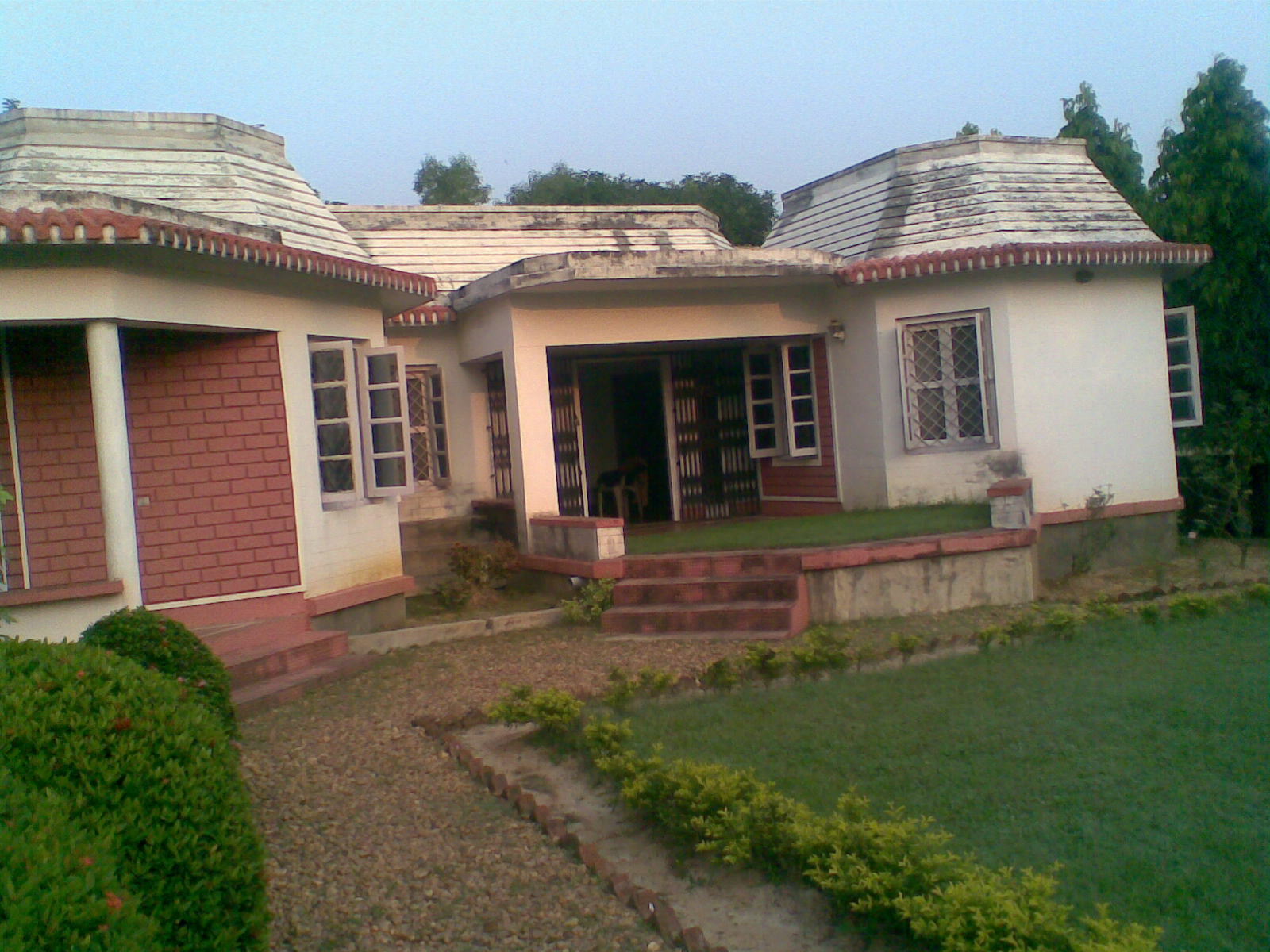
My father, who had never had to build his own house, having inherited a largish mansion from his father, my grandfather, decided that he indeed needed to have his own space and built a tiny but a picturesque cottage off the limits of Shantiniketan. This cottage with gardens and rose beds all around it, shingle roof on top and deodar lines for its boundary looked an absolute fairy land. In this cottage he was to have his own parties and entertain his own friends, cook the way he liked his food to be and enjoy fried stuff for his evening snack and eat soup for each dinner. The cottage was bare, with rather basic furniture but beautifully done up lights. He has a caretaker with who there has been a constant struggle over how to grow vegetables and tend the lawn in the long twenty years that we have built the house and had the caretaker around. Long ago, while the house was still quite new, a smart alec vaastu expert predicted that the house was of bad geometry because it has eight sides to it with two vast open doors in the line of the wind. My parents named it Dishari meaning the compass. I refused to believe him because my father is so happy in the house and everyone who happens to visit it is overwhelmed by its beauty, a beauty that is in its simplicity, much like my father himself.
This tiny cottage that my father built had a die-hard fan who we called PR Kaku, a.ka. P.R Dasgupta. PR Kaku and Prasun kaku were my father’s constant companions in all stages of the house; they stood over while the foundation was being laid, supervised the lintels, and instructed the shingle laying of the roof. When my mother fixed the lights, P.R Kaku gifted my parents with a rare photo of Tagore in a dhuti and Panjabi to be placed below the focus light. When the house was being painted, P.R Kaku himself drew a thin red border along the white exterior of the house giving it a very smart and yet a soft look. The house has always been full of P.R Kaku, his bottle of brandy, the vegetables he would buy to finely chop them for noodles, a dish that would take hours for him to cook. But together with my father and Prasun Kaku, P.R had a great picnic. P.R Kaku supervised the caretaker quite a bit, standing over his head, making him dig out the weeds and pull out the wild grass among the tended ones. To think of Shantiniketan without P.R Kaku is impossible.
Slowly the home at Shantiniketan had its own tribe; my cousin Neela would drop in with over two dozen visitors from all over the world to partake in the Basanta Utsab. Sometimes, on poush mela, the house would be teeming with Neela and her guests. P.R Kaku was also there often, helping my parents to serve the guests, talking and listening to the variety of humanity with Chinese, French, Italians, and Spanish among them. But unlike Neela, who the house claimed on festivals, P.R Kaku was one who the house would have for the quieter moments. In the first bloom of the kamini, in the first rains of ashadh, in the first dew of ashvin and in the first thaw of phalgun when the dew smelt of ice, the house at Shantiniketan had P.R Kaku with it. When I used to be in Shantiniketan and P.R.Kaku happened to be there as well, we often would stand outside the house and watch the lights glow softly from inside the window panes making Dishari look like a dreamland.
Last month, P.R Kaku went to the house at Shantiniketan; he went with a large party of people, his wife, his children, their friends and his attending physicians. He had been diagnosed with an advanced stage of cancer and had not many days to live. He insisted that my parents, their friend, Daliamashi also accompany the party. This, he said, would be his last visit and in his last moments he wanted to be in his favourite place upon this world, the house at Shantiniketan. My parents and Daliamashi came away early and P.R. Kaku stayed on with his team. This time on Mamata Kakima, his wife and the others of his family treated my parents as their guests, pampered them to the core. They did all the spending, did not let my father reach out for his money bag even once so much so that my father in his age related forgetfulness actually forgot whether he ever carried any money! He came to our house in Kolkata to return the keys and gave a full report how he got the lazy caretaker to clean out the house, crop the trees, tidy the weeds and settle the lawn. He thanked my father profusely for such wonderful last days of his life at a house he always thought was out of the world.
This morning of the phalgun purnima, P.R. Kaku died. There is still Neela’s party laughing, running, panting and charging about with cameras and recorders, notepads and mobile phones at the house and enjoying the basanta utsab blow by blow and amidst the imagination of a grand party in Dishari, P.R. Kaku leaves our world very silently this morning. I do shed tears because I was very fond of him, and I cannot bring myself to believe that he will never walk through the gravel path, the soles of his sneakers crunching the pebbles beneath them yet this is the moment I do not lament P.R. Kaku’s demise; instead I congratulate my father. It is not for Neela’s rave parties, nor for the large number of guests, nor for the admiring relatives in the house that building the cottage at Shantiniketan is a redemption for my father; the success of my father’s efforts lie in the fact that a quiet and an affectionate soul like P.R. Kaku thought that my father’s home was his first step into Heaven, the wonderful afterlife. There are not many who can actually create a Heaven on earth and I am proud that my father is one to have done that. There are a few who have the blessings to recognize good fortunes while they have it and P.R Kaku was definitely one of the blessed ones P.R Kaku found his Heaven while he still lived upon this earth is a blessing and that the Divine chose my father to have created that world is a greater blessing. Today,amidst his last rites, I will bow in humility to the benedictions bestowed upon us by the Great One.
Image075

Posted in Obituaries | Leave a comment

Holi Hyay….

Holi Hyay…
Holi is unique to North India and has no parallel anywhere else in the world. This uniqueness is indeed an anthropological wonder, unfortunately never studied by anthropologists. Equally unfortunate is the fact that no historian of India has ever thought of compiling a history of this custom and while there are a few myths here and there, they cannot stand in for a historical account of the festival; its origins and its proliferation. Like all of us, I took Holi for granted till a domestic help from the hills of Kumaon informed me of how Holi is celebrated in his land. Holi is a week-long affair where people keep wearing the colours and smearing each other with coloured powder through the entire period of five days before the full moon. On the day of the full moon people take their bath after the long winter. On the plains of Northern India, the night when the moon waxes to its fullest, Holika, an effigy most ghostly, made out of heaped garbage of dried straw and of shed leaves is burnt and around the bonfire, for the night is still rather cool, gathers a crowd singing and dancing often into the next dawn when colours are slapped on one another. In the east, especially after the Vaishnav movement of Shri Chaitanya, Holi is the Doljatra when it is believed that Radha Madhab comes around to the homes of people, knock at their doors and ask them to pour colour upon the Divine Self. In the Gangetic Plain, Holi is often a drunken revelry, imitating a sex orgy, an excuse to break through the various socially constructed constraints that hold back people from freely mixing with the other.

From a sociological common sense it appears that the Holi must have originated in the Shivaliks because of the strong suggestions of the human menstruation system with the flavour of a rite; indeed the Gods and Goddesses lived in that land and the source of rituals and festivals cannot be denied to the region. The rites of Holi are not really surprising, but the use of colour is. This way of donning colour on human beings, painting one another in colours of flowers and plants is indeed unparalleled anywhere else in the world. Truly when Holi spread elsewhere in the country, the colours were carried off rather than the rites. To burn Holika at stake in Punjab on the eve of the festival is a direct carry over from the witch burning custom of the West. Punjab being home to Aryans may have already a close proximity to territories in which burning of bodies and setting things to fire must have been a tradition. The celebration of Holi by burning the heaped rubbish as if upon a stake may well be a long embedded memory in the deep subconscious of the area. The actual festival of playing Holi is known Dhulendi around Delhi, a name that suggests play with dust. This means that the coloured powder is a euphemism of dust. The act of playing Holi is therefore one of a mudslinging orgy and in territories of the five rivers and the doab, it must have been a covert way of pulling off a riot, attacking with flowers and fragrances, colours and water jets those who the necessities of social order did not allow to do. Trailing down the northern plains into the Gangetic Valley, the Holi is sanctified behind the Radha Krishna cult and becomes licentious where men and women use the festival to mix freely across genders under the guise of deeply tangerine faces.

However it is in the 12th century that Holi seems to have found its aesthetic. The Vaishnav movement sieved Dhulendi of its dust and retrieved its pure colours in the festival of Doljatra. In this festival, the Gods seem to descend right upon your doorstep asking you to paint them with your colours; once you shed your inhibitions and emerge literally in your true colours you then spread your colours to those around you. The Dol in the east has a certain level of anonymity, anyman and everyman should be a recipient of your colours and you of theirs. The Vaishnav movement emerged as a sectarian movement and the Dol was a way of spreading amity and camaraderie.
Whichever way Holi is decoded sociologically and anthropologically, the aspect of colour resists analysis. The colour is the most perplexing aspect of Holi for nowhere in the world, human societies have used colour to celebrate what Holi celebrates while every society in its own way has festivals that are orgiastic or congregational.

Colour is then unique to Holi and in many ways also the fundamental principle of the Indian culture. The term raga used for music means colour; raga when used to depict human emotions also means colour. A person in deep rage is called to be of raga where her face may turn red or change colour. Holi falls in the time of spring, a time when nature proliferates and emerges out of its hibernation which in the hills is snow. Colour is therefore associated with rejuvenation, a renaissance, a moment of birth, an outbreak. The Carl Sagan television shows Cosmos which plots the birth of the Universe in a single calendar year. According to this calendar, 15th March is the date when the Milky Way was formed. 15th March is also roughly the time of Holi. The Milk Way created dust, the cosmic Dhulendi and reflected light in a spectrum producing colour! This is why; colour cannot be really decoded in terms of sociology and anthropology because its significance lies far beyond the human societies, even beyond the Time on earth, into the moments when the Universe was being born. Holi is a remembrance of such Times, a time before Time, the core of colour in the DNA of the cosmos. This is why in Doljatra, Radha Madhab emerges from within the concealed Time before Light and asks for colour from humans, for that is the start of Time itself, when Light gets its meaning as it collides with the dust of stars to spread colour.

http://epaper.dnaindia.com/story.aspx?id=61591&boxid=19684&ed_date=2014-3-22&ed_code=820009&ed_page=10

Tagged , , , , , | Leave a comment

Muddleheaded Middle Class

The Khirkee episode reminds me of a similar incident about seven years ago in Dayalbagh. In those days Dayalbagh was only a fifth as full as it is today and with new buildings coming up the neighbourhood was upbeat about us as being a new colony with promises of a prosperous consuming community. This means that in those days if you called the police they came. We had a young couple for neighbours just about two plots away and often the man would take a while to be back from work and the young bride would join us for tea in our house. Soon she was complaining of strange people coming in our out of the ground floor flat of her building. She felt uncomfortable at the sight of so many different men, always new ones she would insist. Soon others started reporting to me that girls young and bit older were often seen in and out of the flat as well. They all seemed to suggest that there was a call girl racket operating out of the seemingly unoccupied flat. I am not the one to be fazed by such fucks, let people fuck as they want to. At that point of time I was completely liberal towards such “private matters”. But one day, things changed; it seems that three men caught the sight of this young girl standing atop her terrace and decided to climb the two floors up and ring her door bell. They wanted an entry right into her flat. These men were not wholly unknown to her; one among them was our next door neighbour. In a manner of being polite to his new young neighbour he offered sex to her as a compliment! It was at this point that Madhusree decided that she would call the police in. Since it was those days, they did come. In those days the police had not found out that Dayalbagh would be the low brow colony that it presently has come to be; in those days, the game was not yet on its course and so the police could not make out that in the great game of development we were the losers.
The flat was cleared of its contents the next very night with two jeeps full of women police taking the girls away. On the next morning the flat owner, also a woman romped down from her south Delhi residence and raised hell about we being vigilantes and not respecting people’s privacy. Something rather similar to what happened to Khirkee extension actually. I am fortunate to have at least one friend who lives in Khirkee extension and so I know of this locality. It is right next to Malviya Nagar and right behind to Sarvapriya Vihar, spaces quite familiar to my friends but Khirkee extension, no one in my circle have ever seemed to have heard! Someone thought that it was a Muslim village, some thought that it was an unauthorised tenement, some thought that it was a slum and some imagined that it was close to the airport where foreign tourists lived. The society of Khirkee extension was completely unknown to my friends. The difference was that those who lived in this place earned less than what my friends do. Only this slight difference in incomes has been able to create a world so apart that Khirkee seems to be a different planet altogether with different natural laws and different rhythms to its seasons. Khirkee is home to students as well, North east and the Africans dominate the population, unfortunately both prejudiced and harassed categories in the city. In a city with an overwhelming population of vegetarians and with a significant abhorrence to meat cooking in pots, these communities of non-vegetarians are repulsive too. Prejudices are bad things; they are like the false cries of wolves often block the prospect of rescue when the real danger comes. So when the residents of Khirkee complained about the African students, people thought that they were witch hunting.
I know of this place because a friend from Assam lives here; she is also a JNUite and admittedly this makes me more favourably biased towards her to believe her story. She takes me on a tour around the place and I see these flats that are right inside apartment complexes that are built like chawls. Customers confuse doors and sometimes when they are inebriated also confuse faces taking any and everyone as their service providers. Surely this might be a welcome opportunity for someone yearning for sex and I am sure that many a bored women may find such an opportunity exhilarating but there are perhaps more of us whose tastes may be different. The embeddedness of a racket of drugs and sex right into the residential complexes might not exactly be the “commercial purpose” one could allow out of residential areas. My walk in Hell gives me a good idea of what goes on. Complaints are filed and reports are written but never an arrest. The stupidity of Delhi’s lower middle class prejudices against some kinds of people turn against them and they do not seem to be able to register a well worded complaint. In their representations, racial hate flows out making the complaints frivolous. The residents continue to be hemmed in by the growing racket around them; yet not every student from an African country is involved but there is something as being of bad company. The good and the bad stick together; in a city like Delhi they do not feel encouraged to share their woes with fellow citizens, the good among the bad lot are thus severely disadvantaged.
The racket continues; young girls returning from schools are propositioned by customers and pimps and young boys are lured with rolls of powder and who knows even sex. No one in my society knows of this world, for prosperity has shielded them into other kinds of posh localities where they also have gates with security men to shut the rest of the world. There is really no mixing of spaces, mixing up of societies across these gates. The safety of the rich is unknown to the poor, the risks of the poor are disbelieved by the rich; the rich cannot comprehend the poor’s vulnerability while the poor does not know of the rich’s security. Therefore, when the Law Minister from the incumbent AAP Party charged into these flats, the rich saw everything from the point of view of their world, shut off from and secured against the poor and the laws of their world. So when Somnath Bharti stormed into the citadel, his act was seen as being vigitantist, sexist and racist.
Everyone believed the media; not really because they were the media but because the media had people who were richer than my friends. Wealth has interesting shades; one of those interesting greys being the legitimacy of what wealth speaks. The rich man’s sayings are truer than those of the poorer and hence the media, backed by media houses, networked through family and kinship ties to politicians and the police what they said were all true. Bharti was excessively enthusiastic, he was a male chauvinist, he was a moralist and above all he needed to be hated. No one asked why did the police make FIRs against non-existent persons? No one asked why only one particular hospital was identified for the medical tests? No one ever questioned on what the interests of the police were in protecting this racket, no one ever sensed a web of interconnected interests. Instead of questioning the media everyone got busy in the media’s mind game. Is Somnath Bharti a vigilante or not? Whether he set up a kangaroo court or not? Whether Somnath Bharti can walk inside our homes and snatch away our wine glasses, beat up my boyfriends, drag me out into the streets and force me to urinate? Who asked these questions? The media did. These were media’s questions which emanated out of its own reaction to an episode.
The media is magic in many ways; it shows to us what we are supposed to believe is true. In the wired world mired with only mediations of the electronic waves, we are so much like the characters out of the films of Michaelangelo Antonioni who are unable to respond to anything which is real. Hence it occurred to none of my friends that the media was an opinion on an episode and not the episode itself. It could use evidence only selectively. Indeed, an entire discipline of media studies has emanated from such manipulations of the media in which news produced by a few is consumed by many. This already makes media possess disproportionate power and much of the media studies attempts to quell that power by repeatedly asking the question of the access to and interpretation of facts by the media in view of its interest positions. Unfortunately for us, not all are trained media studies persons and hence open to manipulation by the media.
The idea behind Bharti’s raid is atrocious, ridiculous, vigilantism, obnoxious, prejudiced and uncouth. But all this qualifies if the act is what is presented to us. But if the act is not what has been presented the description of Bharti by the media does not fit. The media cleverly manipulates us into imagining that vigilantes are walking into our homes, breaking our curios, scratching our furniture and vanadalizing our honour. The media quietly substitutes the context of quiet upper middle class respectable homes for the Khirkee chawls where random doors conceal prostitution and drugs and in this way, extracts Bharti’s raid to place him right into our drawing rooms. The media is a superior sociologist for they use sociology to manipulate us every day and no one other than the media would ever know that ideals must be located in their material context. This is why, it has cleverly made us imagine that Bharti was acting in the way he did in a world which is a continuity of ours; it concealed the fact that he was dealing with very different levels of objective conditions under which his act would indeed, contrarily have been the moral one. Amitabh Bachchan was a star of my times, and his films used to have such arguments to the core. Thankfully my doctorate is on this star and the media has not been able to fool me.
The media has played on two levels; at one level it has already decided that Bharti’s is an immoral act and asked us to condemn it on moral grounds. Here it accesses our arguments of politicians being naturally corrupt and asks us to reverberate its thesis that here is a case of utter moral corruption. By placing Bharti’s as a moral issue the media has pulled from beneath the rug of arguments the claim for it being a political one. The issue could have been political were we to debate on the context; why did the police not heed to the residents on their complaints, what did the residents find objectionable, was it prejudice against the Africans and women, or were the objections for real. These questions and such questions could have helped us to travel into larger dimensions of politics. We could have asked are Delhiites witch hunters, do we like the Cold War America also suffering from Mac Carthyism? Is the police class conscious? Does it treat its citizens who do not live in the posh localities like they have done? Possible replies to these questions would have opened up the real dimensions of politics that would have made it easy for us to understand the various nexus and networks that bind politicians, media and the administrators to rot every possible institution of the society. Institutions fail not because they have lost their ideals, for everyone knows how to mouth these ideals and moralisms; institutions fail because they, through their crony connections keep off those who claim entry on purely the grounds of merit. The networks close off societies that were supposed to be redeemed as open ones. Morality is the instrument of the entrenched to ward off questioning. This has been true for almost every revolution under the sun; morals are challenged during any and every change.
The second level the media has played on is to break the confidence of the Aam Admi supporter. The plank of the party is morality because anti-corruption is its principle battle. To the corrupt, an anti-corruption drive is vigilantism, it attacks one’s wealth, it has raids, and it has people coming inside your homes to take away your possessions, your lifestyle. By projecting Bharti as one who walks into your homes objecting loudly to the freedom of lifestyle you lead the media has pushed all of you who supported the AAP’s agenda that the entrenched and the corrupt must be attacked into one of your own enemies. In a manner we are all becoming the murderer of Psycho, where he murders by donning his mother’s clothes because he was so oppressed by his mother that as soon as he felt attracted to women, he would assume his mother’s persona and kill the young woman off. Psycho went onto become Hitchcock’s greatest works and it inspired and continues to inspire film makers even today. Psycho was made at the conjunction of two eras of America, one in which its new middle class challenged the order of the corporate militaristic ruling class. Though latched upon a psychotic hero, Psycho became the metaphor of people turning against themselves by internalising the language of the oppressor. The language of the oppressor would invariably be moral and things would be taken out of context to absolutize truth statements. Psycho is being played out through the media’s moralising a political question in which we, like Norman bates assume the persona of our oppressors because our oppressors start finding fault with us whenever we try to realise our dreams.
Morality is central to the middle class, so is moralising. Anti-corruption motto of the Aam Admi can only be a middle class because of its high moral tone. Yet the middle class keeps to its morals; the khaap’s honour, the honour killings, the rise of conservatism and the recent recruitment of professionals in terrorist outfits are extensions of this middle class morality. Morality is pertinent to the middle class because morality is instrument through which it guards its own class from being predated by the wealthy or falls prey to poverty. Its morality helps in the creation of the family, in sustaining its social capital.
The function of morality of the middle class is not merely an ideal, it is an important objective affair because by transgressing the moral limits the middle class can access means that help it to break out of its ilk and stand above its milieu. This is exactly what has happened through corruption in India; people of similar means have earned disproportionate rewards through transgressing the moral limits. Then they have become a rich class that can afford cars, flats, clothes and others. Since wealth brings about certain legitimacy, this richer class too defined our goals for us. We all thought that we lived to earn for a life style and indeed life style politics by driving up consumerism cracked the very crux of middle class from one that was an intelligentsia and literati into one being a glitterati. Once we are on the path of consumerism, we oriented ourselves along planks that would help us with the money. The middle class pursued that kind of education that made it seek shelter in the wealth generating corporate houses and the industry, made them into fortune seeking NRIs and when they were more autonomous people as bureaucrats plunged them into corruption. In all such pursuit of education the middle class only plotted its way to be close to wealth. This was a complete reversal from the days when the middle class would produce ideas, intellect and knowledge. The media, owned again by the wealth class was now the producer of knowledge, and hence started to define the very ground for the middle class. The wealthy now seemed to define the middle class as a class in itself; the media defined its morality, the industry defined its profession while the advertisements defined its needs. Through such definition, the wealth class took charge of creating the middle class, where it forever moved the bar of the middle class into higher and higher income levels. The middle class depoliticization was complete in a mad rush to pursue wealth; its fall into corruption was also due to this.
The above process turned the middle class against itself; those who had more possessions guarded it from sharing with the rest. Families were the first institutions to go; better off relatives were no longer in a mood to stand beside the less successful and earning more for the household was all that one could think. At no point of time in its history was the middle class so stressed over money as it is now. Corruption is a symptom of this deeper anxiety over status that for the middle class only money can beget. Privileges were also guarded in the form of coteries and clubs; even the departments in Universities are filled with similar people those who knew one another. I attended a course in the India Habitat Centre which was strangely attended by people who I realized knew one another. The rise of ethnic politics is essentially middle class politics; communal politics is also middle class politics. Everywhere spaces are getting closed, only familiarity speaks, connections speak; gone are the days of open societies today we are looking to developing known circles of friends of mutual support so that our ideas totally disconnected from the objective reality are nonetheless legitimised on affectionate considerations. The rise of the gated colonies of high rise apartments is symbolic of the enclosures of the middle class by which this class in itself fights its own members. The middle class’s transformation from an intelligentsia to a consumer has broken its own moorings, made its existence into a zone of civil war.
The wealthy breaks the middle class through its ownership of morality. What the middle class no longer notices is what this morality consists of; does it have its own objective base or is it some manufacture from above. The media seems to be a good hand maiden to manufacture morals first by defining such morals and then by obliterating the location of such morals from their objective embeddedness. This is what has happened; we never know whether the Batla House encounter was of terrorists or of boys mess; we similarly have assumed that the drug racket was only a tourist party and that the sex den a paying guest accommodation. Keeping the veil of normalcy as it is, the act of Bharti becomes demonic; but to turn one’s attention to the facts where the harmless routine of everyday life conceals the lurid reality of customers knocking randomly at my door, Bharti is indeed a relief. Just as Bharti’s act of raiding shocks us from the perspective of our well protected lifestyles, but seen from the viewpoint of a single woman as I having to hear knocks from strange men who assume that I am on sale is abominable. In such a situation, Bharti is my messiah.
I think that my politics with the Aam Admi is all about recovering my self-respect and this I can only do when I generate the language of my reality, pursue possibilities that transform my opportunities. And this I can do by recovering my good sense to generate my language, my concepts, my theories from my perspectives rather than play only a verbal game proffered to me by the media where anchors are cued in to their onwers’ commands with that microphone fitted into their auditory meatus.

Posted in Politics | Tagged , , | Leave a comment

The Life Trajectory of Krishna Dasgupta a.k.a Suchitra Sen

I did not know till I heard it on television on the reminiscences of her biographer that Roma Dasgupta was enrolled as Krishna Dasgupta in school. I also had no idea that during her wedding ceremony, Roma refused to wear the veil. I thought that she did not need to wear the veil because Brahmos are not required to do so. Roma was Hindu but her husband, Dibanath Sen could well have been a Brahmo. Dibanath was Adinath’s son and Adinath was Hemlata and Sukhalata’s brother. Hemlata Sen married Jogeendranath Dasgupta. They were my grandfather’s parents. Dibanath and my grandfather were cross cousins and Roma was therefore a pretty close relative. But that was when she was Roma; after she became Suchitra Sen, the family chose to forget her and why not, because Roma was a relative, not Suchitra Sen. A photo parched and frayed of them as a young couple made me realize that Moon Moon Sen, Suchitra’s only child looked so much like the father Dibanath. Stories in the family around Dibanath were not encouraging; he was supposed to be a sparer, a gambler, a dilettante and so on. The father Adinath was a lawyer and rich; he was a jolly fellow except that my grandfather’s older brothers had issues with him. I think a combination of Dibanath and Adinath, marinated in doses of villainy became the maleficent husband of Suchitra Sen in the film Uttar Phalguni, also remade in Hindi as Mamta. Roma was of course never happy in the marriage and she refused to acknowledge her in laws. She lived all by herself, reclused, hidden away and mysterious if not mystique. Despite the media being all ears, Suchitra’s affairs were never leaked to the press. People were far too afraid of her to step on her toes. Hers were days rather different; icons were icons because they were not seen, they had not turned into celebrities because they would be seen everywhere.

Suchitra Sen’s biographer, Phularenu Kanjilal says that Krishna was always the way she finally emerged on screen. She was haughty, snobbish, moody, peevish, absent minded, self-absorbed, self-confident, wilful, assertive and totally in command of herself. And she was beautiful. She was conscious of her great beauty, totally unapologetic about it and behaved as if she was bestowed upon with such glory because she was worth it and deserved every bit of the natural selection. Krishna may have not been very fair and there is a debate in the house whether she was indeed dark, but she may not have been the powdery white which her sisters were. Hence she was called Kirshna, the dark one, or the darker one. Krishna could walk into the class with her hair open, she always spoke with her stiff upper lip and curled up lower lip, she looked with large eyes, often obliquely. In other words, the style and the mannerisms that eventually made her into the star she is was very much a part of her while in the teens. It seems that one afternoon, Krishna sat reclined on the bench in class and staring blankly at the space before her said that she would like to be remembered long after her death. Given the fact that she was completely mediocre in her studies, music and dance and had no talent to make her stand out such an assertion seemed to her friends as absurd. She had her beauty; but that was not enough. In those days, getting a chance on the silver screen was even more difficult. Her husband’s father’s unmarried sister used to be a top model in Kolkata in those days but then the family was among the glitterati of Kolkata. Roma’s father was a dignified middle class teacher and her excessive beauty was supposed to have found a great destiny into being married into Hemlata Sen’s family. Her beauty was supposed to have played the very role that it was supposed to play and exhausted its full possibilities.

But Roma’s arrogance would have none of this; her marriage meant nothing to her and she ventured to conquer the world, a Bengali middle class, very middle class, saddled into sharing space and resources with as many as eight siblings, just about average in studies from a Bengali medium locality school and a shade darker than her sisters. She had actually nothing to her credit, nothing that could stand as a background. She had only herself, her beauty, more in her own estimation than for the rest, for she was a shade darker in her skin. But her mannerisms, her affectations ever since childhood as her biographer writes perhaps means that she was ostensibly conscious of the fact. And she believed in being entitled because of her endowment and demanded that the world should fall at her feet not because what she could deliver but just because who she was. And from this attitude arose the icon, Suchitra Sen, one that Bengal would possibly never see again. It was Suchitra Sen’s attitude that made her the great star that she was and she swayed an entire culture with her gait and her gaze, her manner of holding back the head, the way of her reserved coquetry.

The stardom of Suchitra Sen did not emanate so much from the roles which she essayed; her stardom emerged from her own off screen personality. Scripts were written to suit her and if she ever acted in Griha Daha or in Debi Choudhurani or Datta, these characters were like her own. She was born to be looked after by a caring boyfriend or a rich father and in Debi Choudhurani when she had neither, the lord of the underworld, Bhabani Pathak raises her to become Empress. But she was not a damsel in distress; she was one who commanded protection, ordered men about to do her stuff. When she lost her pet dog on a journey to a farm house she insisted that her class fellow, Uttam Kumar, the star to spend the entire night in open looking for the dog! She was the only female lead opposite Uttam Kumar who actually could make the hero or heroes of Bengali cinema go down on his knees to appease her. Sociologically this ego is rooted in the long tradition of Bengal and in its modernity; but such discussions do not constitute the scope of this obituary.
Suchitra’s arrogance made her emerge as an interesting person on screen. Though vulnerable at the core, she covered this up with a haughtiness; the same haughtiness that also made her capable of a strange loyalty and self-sacrifice to the extent of self-abnegation and annihilation. . She may want love, but she would prefer to give love rather than to ask for it; the men are supposed to guess her needs through a sincere reading of her life trajectory. She was quick to develop obsessions and eccentricities, to become prejudiced and sometimes too hasty in her judgments and actions. These flaws only added to her glamour and it needed a man like Uttam Kumar to stand as her alter ego, bear the perfection that could be achieved through the elimination of her blemishes. Uttam Kumar absorbed her shortcomings and restored her in settings in which her ego could again recover from hurt and recover the confidence to resume her high handednessIt was in her that the Bengali audience discovered her ego and it was in the comely man, Uttam Kumar that the Bengali knew softness. Together they represented the pair unmatched to this date; it was a pair of ego and arrogance and of protectiveness and nurture. It is unfortunate that Western categories so dominate our discourses but in the Indian culture, harsh haughtiness is often associated with beautiful women and comely surrender with powerful men, the quintessential Durga and Shiva or Kali and Shiva. Suchitra Sen created the Bengali femininity, the feminine force which believes that the world exists to serve them; that they would always need to be paid obeisance to and hence the need for being protected should never be made obvious or acknowledged.

Suchitra’s total withdrawal from the public gaze was also the result of her arrogance; if she is not queen of the silver screen then she better not be seen at all, seems to be her refrain. It was a strange my way or the highway situation; she had always to be taken in her terms and not in any others. She never knew how to bend, she would better be broken than be bowed. Sometimes I thought that this was a rather lack of grace, but she was always the only one in her world and insisted that she would continue as the distant Goddess rather than to walk the earth with fellow mortals. In this cordoning off, even her own were not spared. Moon Moon had a tough time with her, despite the fact that she was the only child and while Suchitra decided that she did not want anyone, she never really stopped to wonder whether there were others who needed her.

Posted in Media Sociology, Obituaries | Tagged , | 5 Comments

Politics of Sexuality – Article 377

India’s is the world’s longest written Constitution that way back in 1950 assured equality and liberty to women, poor, illiterate, homeless, orphans, oppressed and the marginalized . Yet, as is revealed, a core of repressive conservatism remained in the form of Article 377 which criminalized sex between consenting adults, which was not conceived to be in the order of nature. Hence homosexuality and transgender sex came under its attack. The history of this Act can be traced to a law in 1861, passed by the British colonialists, reminding us of Michel Foucault’s magnum opus, the three volume treatise on the History of Sexuality. It appears from Foucault that modernising Europe was keen to restrict the definition of sexual pleasure only to sex between man and woman of similar ages, a combination which produced children within matrimony. The ancient Chinese since uncertain hoary days had restrictions which regulated intercourse to days that could beget the male child. India’s own Kamasutra fine tunes recipes for maximum sexual pleasures which prescribe heterosexuality. 16th century Europe may have been keen to reproduce itself biologically to counter the damage to its population caused by the Crusades and Plague in the earlier centuries but also to consolidate the institution of the family for a steady supply of soldiers, peasants, yeomen and other workmen for its growing factories. The Kamasutra was on the other hand, an attempt at consolidating the society on the basis of uniform marriage patterns that included heterosexuality. It was also to foster a high culture and an aristocracy through prescribed standards of pleasure and enjoyment.

The VHP and the RSS’s thesis that homosexuality is an imported affair like most of its theses completely ahistorical. Ved Vyas, the composer of the Mahabharata had diverse sexual preferences which started from bestiality and became more and more varied to the scandal of the Aryan epic society. The ruling over some kinds of sex acts as being unnatural was an Aryan import, to regulate and at the same time intermingle in an indigenous Indian society.

The present sentiments against homosexuality and transgender sex however are proscriptive rather than prescriptive. These sentiments emerge within the right nationalists in response to the loss of the “centredness” of the Indian society around the family. Its invocation of parivaar in every walk of life is perhaps a desire to lionize the institution of the family so that spaces those which are outside the family are imagined to address the individual more softly and kindly. If the State is ruled as a family, the citizen becomes a member of a large family; if offices are run along principles of family, then individuals expect to feel more protected against impersonal rules and disciplines. The right nationalism in India is the politics of creating family like comfort zones all around one’s self and this can appeal to an entire range of individuals fearful of performing as free atoms in the public sphere. The right nationalist’s agenda of genocide is an extension of this fear, an attempt at elimination of the “other” whose presence requires the opening up the walls of the ensconced familiarity of the family. In the same way, the right attacks various forms of sexualities those which are neither supportive of the institution of the family nor can reproduce the family. The intolerance of diversity, whether of ethnie, or cultures, or ways of being and its upholding of a nation on the discourse of the parivaar is the bravado of a person who fears participating in the world as a wholly developed adult.

Posted in Politics | Tagged , , | Leave a comment

Social Class In Delhi Elections

Facebook sites are agog with slogans, Nikalo aaj makaano se, jung ladho beimano se..exhorting citizens to vote for the candidates in the Delhi elections. The mainstay of the present elections seems to be corruption, thanks to the presence of the Aam Admi Party, the new presence that promises clean politics. This elections has no issues around it and yet voters are sharply divided into two groups and the three camps; the Congress, the BJP and the Aam Admi Party. There is a group which would vote for the Congress as a reward for what it has done for Delhi while there is another group who find the Congress government to be corrupt and callous. The latter group is divided into two further camps; the older and middle aged persons well entrenched into their life statuses while the other comprises of younger people with dreams, hopes, trepidations and anxieties as those the youth suffer anywhere in the world. These groups are so well divided that if one knew the background of the voter one could easily establish her voting preference.

In the circle that I move around everyone is a Congress voter. These are the rich who, during the regime of Congress in Delhi have become richer. Expectedly then they would be loyal to a system that has helped them grow. The BJP voters are those who have typically not done too well, struggled to improve their lot, and slipped back despite the hard work. This kind is likely to be resentful of a regime which has created opportunities which were for others. The BJP is an ideology based on the attack of the “other”; it might be the Muslims as a concrete category but in a generalized sense, its ideology is to attack the one who seemingly has beaten them to the finishing line. The voters of the Aam Admi Party are the educated middle aged and the aspiring youth, both of who desire to shape their lives up, need to take command over the future, the control the political discourse, invigilate governance and emerge as a moral force to regulate the rest of the society.  The desire to rule is the strongest in the Aam Admi Party voters.

Politics of elections are expressions of social conflicts and contestations. The entrenchment of a Party, especially like that of the Congress in Delhi was indeed a sign of satisfaction which the citizens of Delhi had with the Sheila Dixit government. She used urban development as her plank to legitimize her rule and truly then urban infrastructure was supposed to have helped everybody access superior opportunities in the city. But development has its own pitfalls; everybody wants to come into a city with facilities which lead to overcrowding, desperations and therefore in the rising crime rates. Corruption is bound to rise with speculators of food products, private electricity companies raising bills to fancy rates and the city administration descending on people with land acquisitions, clearings and demolitions. Overpopulation raises prices of goods and services making it difficult for the local population of the city access instruments needed for a decent living.  The local population who loses out to the new economy of Delhi is the largest support base of the BJP.  The local people and the new migrant who has benefitted in their various capacities and made more money through Delhi’s large scale public investments are the Congress’s bastions. But the professional, the academic, the educated who is perhaps the first generation migrant into Delhi, who has the power of thought and articulation and who has decided that a city driven only by the power of money instead of the power of culture and erudition is effete and crass is the voter for the Aam Admi Party. This is why we find in colleges and schools, in courts and bureaucracy, among the youth in the marginalized slums of Delhi, the young persons with bare graduate degrees in call centres, the ushers of cinema halls, the hands in the shops of the malls vote desperately for the Aam Admi Party. They are calling for a change in the order, an order which will be ruled more by the moral terms of this new brand of the educated and the professional and perhaps the salaried, or what we would call as the middle class intelligentsia a century ago.

Posted in Politics | Tagged , , , | Leave a comment